

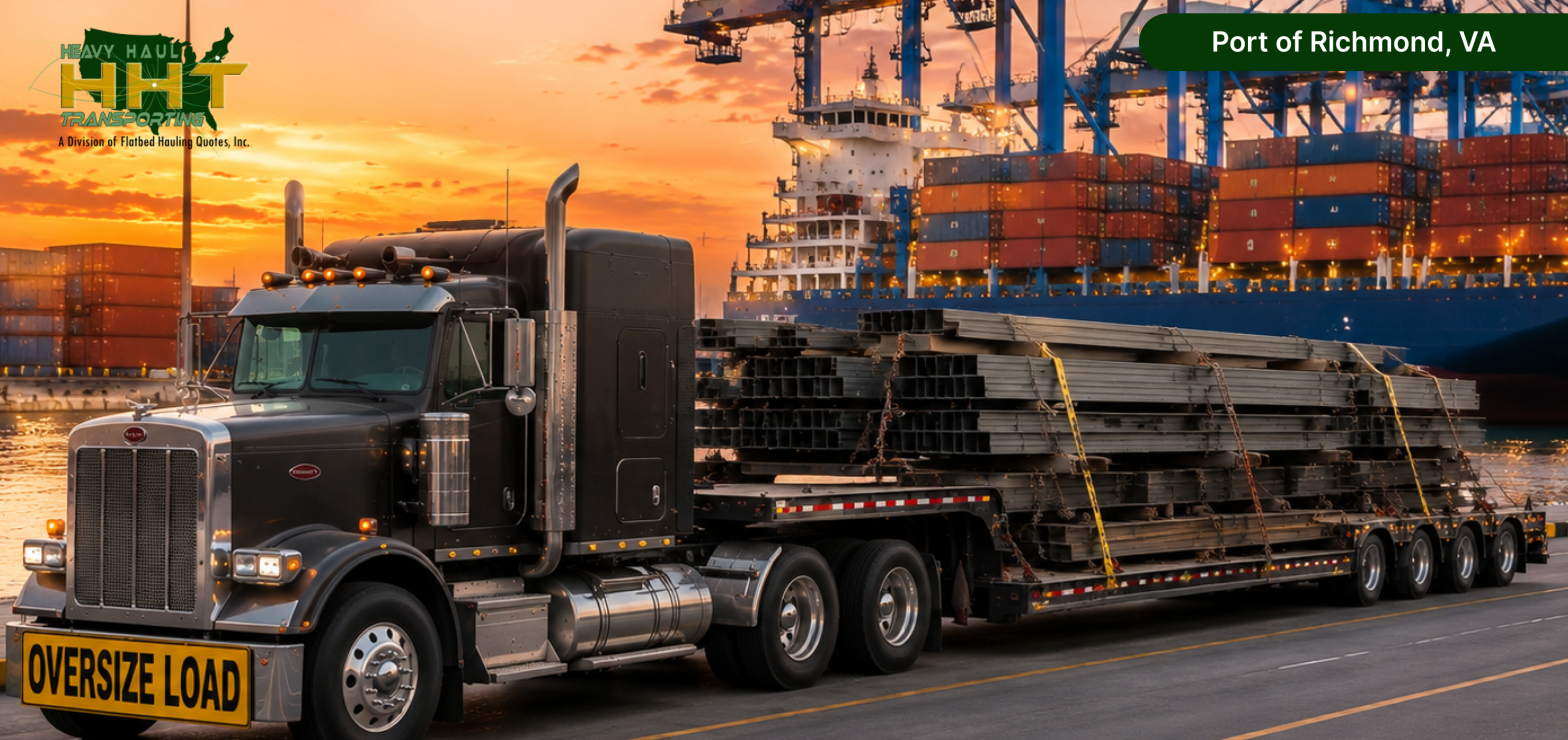
Heavy Haulers Port of Richmond, VA
Moving Oversized Freight Beyond the Port
Heavy Haulers Port of Richmond matter because cargo leaving the waterfront often needs careful road planning before it can reach a jobsite, plant, or yard. At Port of Richmond, VA, Heavy Haul Transporting helps move oversized freight by road after it clears the gate, using trailers and route planning built for heavy loads. Richmond sits in a useful spot on the East Coast, with access to manufacturing, construction, energy, and defense supply chains that depend on oversized freight shipping and heavy equipment transport.
Port activity in Richmond supports a wide mix of freight flows. Industrial buyers move steel, machinery, power gear, and modular units through the Richmond port area, while contractors look for heavy haul trucking that can handle weight, height, and route limits on Virginia roads. That is where Heavy Haulers Port of Richmond work becomes practical: the load may be too tall for a standard lane, too heavy for a basic trailer, or too wide for a simple turn through city streets.
Heavy Haul Transporting does not handle loading, unloading, customs brokerage, warehousing, ocean freight, or freight forwarding. Our work starts once the cargo leaves the port gate and needs over-the-road transport across Virginia or anywhere in the United States. For shippers moving heavy machinery transportation, oversize load trucking, or equipment transport, the route matters as much as the freight itself.
Port Industries and Economic Impact
Heavy Haulers Port of Richmond support a regional economy that reaches far beyond the riverfront. Richmond’s location connects industrial buyers to inland Virginia, the Mid-Atlantic, and the broader East Coast, which makes the Richmond port area useful for manufacturing, construction, economic development, and international trade. When factories expand or contractors win new work, they often need heavy equipment transportation companies that can move large assets without delay.
Manufacturing plants around Richmond and nearby corridors often bring in industrial presses, electrical cabinets, large generators, and structural steel beams. Construction firms need flatbed trucking companies and heavy equipment haulers for excavators, bulldozers, cranes, and concrete pumpers. Energy projects also create demand for oversize freight shipping, especially for power transformers, substation modules, industrial boilers, and gas and steam turbines. Those moves are common when utilities upgrade grids or when alternative energy and solar projects need large components delivered on a tight schedule.
The Port of Richmond, VA also serves freight tied to defense contracting, aerospace, and military suppliers. That can include armored vehicles, spacecraft and rocket components, and modular control rooms. In those cases, Heavy Haulers Port of Richmond service is less about volume and more about precision. A load may need a route survey, a permit review, or a specific trailer choice before it ever leaves the yard.
Heavy haul transportation in this market also reflects fuel prices, labor demand, and project timing. When a plant needs a machine on site or a contractor needs a steel package moved, the right heavy haul shipping companies keep the supply chain moving by road.
Heavy Freight Moving Through the Port
Heavy Haulers Port of Richmond often handle freight that cannot move on a standard dry van or box trailer. Around Port of Richmond, VA, we see construction and mining machinery, excavators, articulated dump trucks, motor graders, and rock crushers moving toward job sites and fabrication yards. We also move energy and power infrastructure such as large generators, electrical substation modules, industrial boilers, and power transformers.
For heavier industrial cargo, flatbed heavy haulers and heavy machinery haulers choose the trailer that fits the load instead of forcing the load to fit the trailer. Flatbeds work well for steel, pipe, and many machine components. Step Deck trailers help with taller freight that still needs a lower deck height. Lowboy trailers are common for bulldozers, cranes, and other dense equipment. RGN trailers make loading easier for tracked machines, while Double Drop trailers help with tall cargo that needs extra clearance. Multi-axle trailers spread weight for oversized load transport, and Schnabel trailers can support extreme pieces when the dimensions call for specialized engineering.
Heavy Haul Transporting uses that trailer mix to match the freight, the route, and the permit. In the Richmond port area, that can mean moving heavy equipment transport for industrial buyers, construction equipment shipping for contractors, or oversized load trucking for utility projects. The goal is simple: keep the cargo legal, balanced, and ready for the road once it leaves the gate.
Transportation Challenges and Route Planning
Heavy Haulers Port of Richmond require more than a driver and a trailer. At Port of Richmond, VA, route planning starts with Virginia oversize permits, axle weights, height limits, and width restrictions that can change depending on the load and the road. A move that looks simple on paper can become complicated if bridge clearances are tight, if a turn radius is limited, or if a city street creates a problem for over-dimensional hauling.
That is why route surveys matter. We check the path before dispatch, especially when the freight includes heavy equipment transportation companies’ typical loads like transformers, modular structures, or industrial machinery. In Richmond, the route may need to avoid low bridges, sharp ramps, or construction zones that affect heavy haul trucking. Weather also plays a role. Rain can affect braking and visibility, while wind can create issues for tall freight such as tanks, cabinets, or pre-fabricated building modules.
Fuel prices also influence planning. Longer detours, idle time, and stop-and-go traffic all affect operating cost, so the route has to make sense for the load and the schedule. Virginia transportation regulations can also require escort vehicles, timing limits, or special movement windows. Heavy Haulers Port of Richmond work is about balancing all of that so the freight can move safely and legally from the Richmond port area to the next destination.
Heavy Haul Transporting serves Port of Richmond, VA with road-only oversized freight moves across the United States. Heavy Haulers Port of Richmond shipments stay on the highway after they leave the gate, and our fleet includes flatbeds, step decks, lowboys, RGNs, double drops, multi-axle trailers, and Schnabel trailers. That mix supports heavy haul truckers moving machinery, steel, energy gear, and modular freight from the Richmond port area.
Heavy Haulers Port of Richmond keep industrial freight moving where Virginia’s roads meet real project demand. At Port of Richmond, VA, the mix of manufacturing, construction, energy, and defense cargo creates steady need for oversize load trucking and heavy haul transportation. If your freight needs road transport after it clears the gate, Heavy Haul Transporting can help plan the move with the right trailer and route. The Richmond port area will keep generating oversized freight shipping opportunities, and that makes careful planning even more important.
Planning Heavy Haul Transport From Port of Richmond, VA?
Heavy Haul Transporting helps businesses coordinate the movement of oversized freight, industrial machinery, construction equipment, and project cargo throughout North America.
Primary Road Corridors Out of Port of Richmond, VA
The Port of Richmond, VA connects oversized freight to major transportation corridors across Texas and the United States. These highways are frequently used for moving construction equipment, refinery components, heavy machinery, wind energy equipment, and oversized industrial cargo after it leaves the port area.
I-95 is one of the main north-south routes for Port of Richmond, VA freight, and Heavy Haulers Port of Richmond often use it for machinery, steel, and power equipment moving toward central Virginia or beyond. The corridor matters because it connects industrial freight to regional manufacturing sites, construction projects, and distribution yards without forcing a long local detour.
I-64 gives Port of Richmond, VA direct access to east-west freight movement, and Heavy Haulers Port of Richmond rely on it for oversized load transport tied to utilities, modular structures, and heavy equipment transport. It is a key route when cargo needs to move toward inland markets or connect with other Virginia corridors that support project freight.
US-60 is important for Port of Richmond, VA moves that need a more direct path through the Richmond area, especially for construction equipment shipping and heavy machinery transportation. Heavy Haulers Port of Richmond use this corridor when route planning calls for a practical surface-road option for oversized freight shipping and local industrial deliveries.
US-1 and VA-33 help connect Port of Richmond, VA freight to nearby industrial zones, and Heavy Haulers Port of Richmond use these roads for equipment transport that must avoid tighter interstate conditions. These routes matter for loads like generators, fabricated steel, and other heavy freight that still needs careful clearance checks and permit compliance.
Frequently Asked Questions About Port of Richmond, VA Transportation
The Port of Richmond, VA, handles a variety of oversized freight, including industrial machinery, construction equipment, and large components for energy projects. Heavy Haul Transporting specializes in transporting these large loads efficiently to meet your logistics needs.
In Virginia, you'll need special permits for transporting oversized loads. It's essential to check with the Virginia Department of Transportation for specific requirements based on your cargo dimensions. Heavy Haul Transporting can assist with the permit process to ensure compliance.
For heavy hauling from the Port of Richmond, VA, flatbeds and lowboys are commonly used. These trailers accommodate oversized loads while providing stability and support during transit. Heavy Haul Transporting can recommend the best equipment based on your specific needs.
The Port of Richmond, VA, serves various industries, including construction, manufacturing, and energy. These sectors often require heavy hauling services for large equipment and materials. Heavy Haul Transporting is well-equipped to handle these specialized shipments.
After cargo leaves the Port of Richmond, VA, it typically moves directly to its destination via designated routes. Heavy Haul Transporting coordinates the logistics to ensure timely delivery while adhering to all regulations for oversized loads.
Yes, Virginia has designated routes for heavy haulers that avoid low bridges and narrow roads. It's crucial to plan your route carefully to ensure safe transport. Heavy Haul Transporting can help you navigate these routes effectively.
Safety is a top priority at the Port of Richmond, VA. Heavy Haul Transporting follows strict safety protocols, including route assessments and load securement, to ensure safe transport of oversized freight.
Absolutely! Heavy Haul Transporting offers comprehensive logistics planning services for shipments from the Port of Richmond, VA. We ensure that your oversized freight is transported efficiently and in compliance with all regulations.
NOAA Port Intelligence Related Pages
RELATED POSTS
Heavy Haulers Port of Whitman County Keep Whitman Freight Moving by Road
Heavy Haulers Port of Eastport and the Road Moves That Follow
Heavy Haulers Port of New Orleans Keep Oversized Freight Moving by Road