

Multimodal transportation provider Schneider National handily beat second-quarter expectations and raised its full-year earnings outlook. It said a capacity constrained truckload market is “only in the early stages of rate recovery” and that it will use the favorable imbalance to “recoup multiple years of significant cost inflation.”
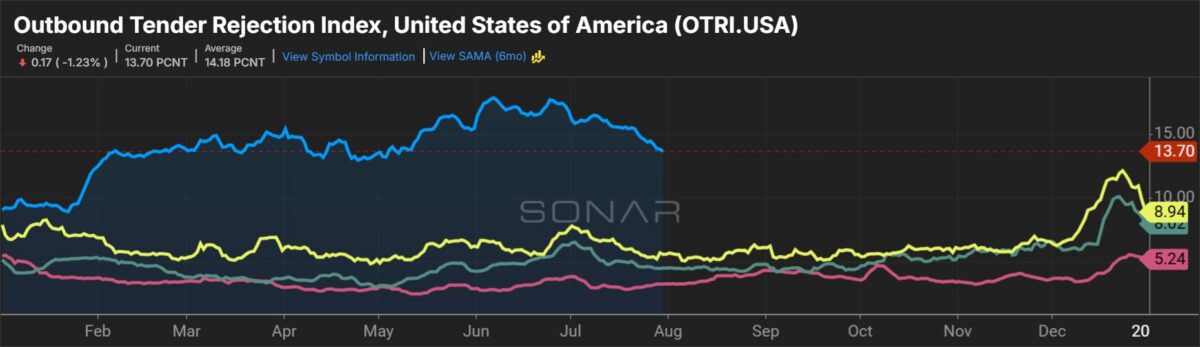
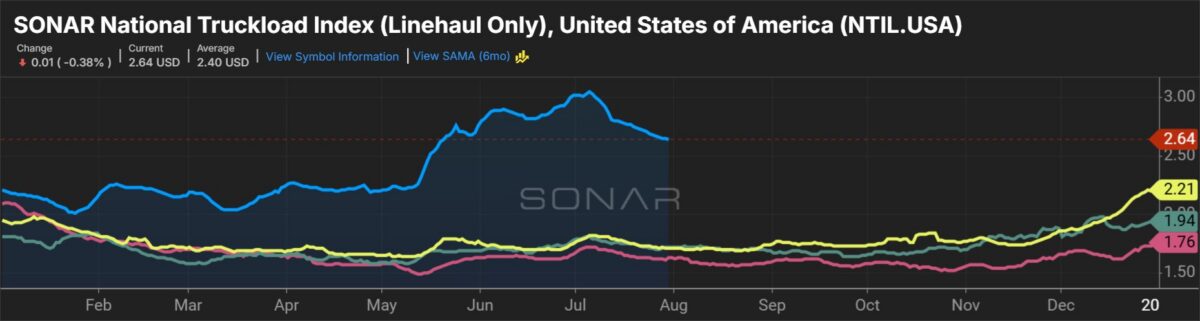
Schneider’s (NYSE: SNDR) network fleet (one-way) captured double-digit rate increases on contract renewals in the quarter. Mini-bid activity is up as shippers grow more concerned with securing capacity for peak season. Schneider increased its spot market exposure, noting June closely resembled March 2021, the prior cycle peak.
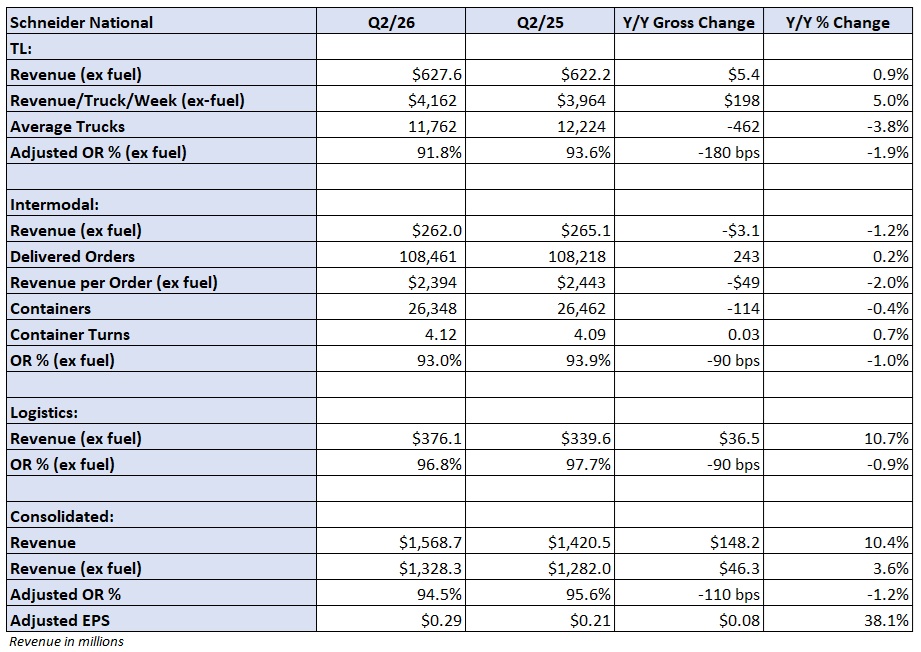
Schneider reported adjusted earnings per share of 29 cents for the second quarter, which was 6 cents above the consensus estimate and 8 cents higher year over year. Consolidated revenue of $1.57 billion was 10% higher y/y and better than the $1.52 billion consensus estimate.
The company raised its full-year adjusted EPS guidance to a range of 90 cents to $1.10, an 18% increase from its previous outlook (at the midpoints). The 2026 consensus estimate was 96 cents at the time of the print. (The company reported full-year 2025 adjusted EPS of 63 cents.)
“The positive impact of non-compliant capacity exiting the market has been realized more quickly than initially anticipated, and we remain confident that the enterprise will continue to deliver strong operating leverage,” said President and CEO Jim Filter.
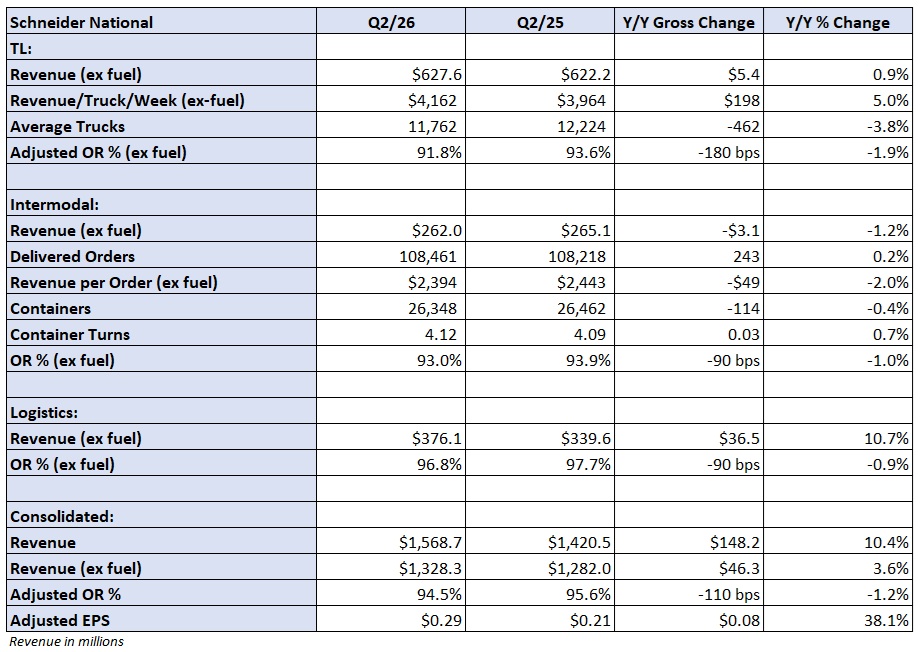
Truckload revenue increased 1% y/y to $628 million as a 5% increase in revenue per truck was partially offset by a 4% decline in average trucks in service. The company said the lower tractor count was largely due to a tighter driver hiring market. However, improved asset utilization is offsetting the lower truck count.
The one-way fleet recorded a 16% y/y increase in revenue per truck per week, with dedicated reporting a 1% increase.
It flagged the loss of a large dedicated customer, which will be a headwind in the third quarter. This has been accounted for in the company’s guidance. It sold dedicated service on 500 new trucks in the first half of the year. It said new dedicated contracts will backfill some of the open trucks from the customer departure, but it may also move some units over to the one-way fleet to take advantage of the spot market.
The TL unit reported a 91.8% operating ratio (inverse of operating margin), which was 180 basis points better y/y.
Intermodal revenue slid 1% y/y to $262 million. Revenue per load was down 2% as length of haul declined. It said the unit is getting low-single-digit rate increases currently, but more recent contracts are renewing with mid-single-digit increases. Finding drayage drivers is getting more difficult, but Schneider isn’t adding third-party operators to chase volume.
The intermodal unit reported a 93% OR, 90 bps better y/y.
Logistics revenue increased 11% y/y to $376 million. The unit booked a 96.8% OR, 90 bps better y/y.
Net debt leverage ended the quarter at 0.2x, down from 0.3x at the end of 2025. Schneider lowered its full-year net capex plan to a range of $350 million to $400 as it purchases fewer trailers than previously planned. Net capex totaled $289 million in 2025.
Why it matters? Schneider National’s results serve as a bellwether for the health of the truckload and intermodal markets. Its commentary on rate recovery and capacity management provides a benchmark for other asset-based carriers.
More FreightWaves articles by Todd Maiden:
- Saia’s Q3 margin guidance disappoints investors
- XPO’s Q2 earnings beat expectations behind strong LTL performance
- ArcBest’s Q2 a step on path to recovery
The post Schneider National pushes price amid market imbalance appeared first on FreightWaves.