

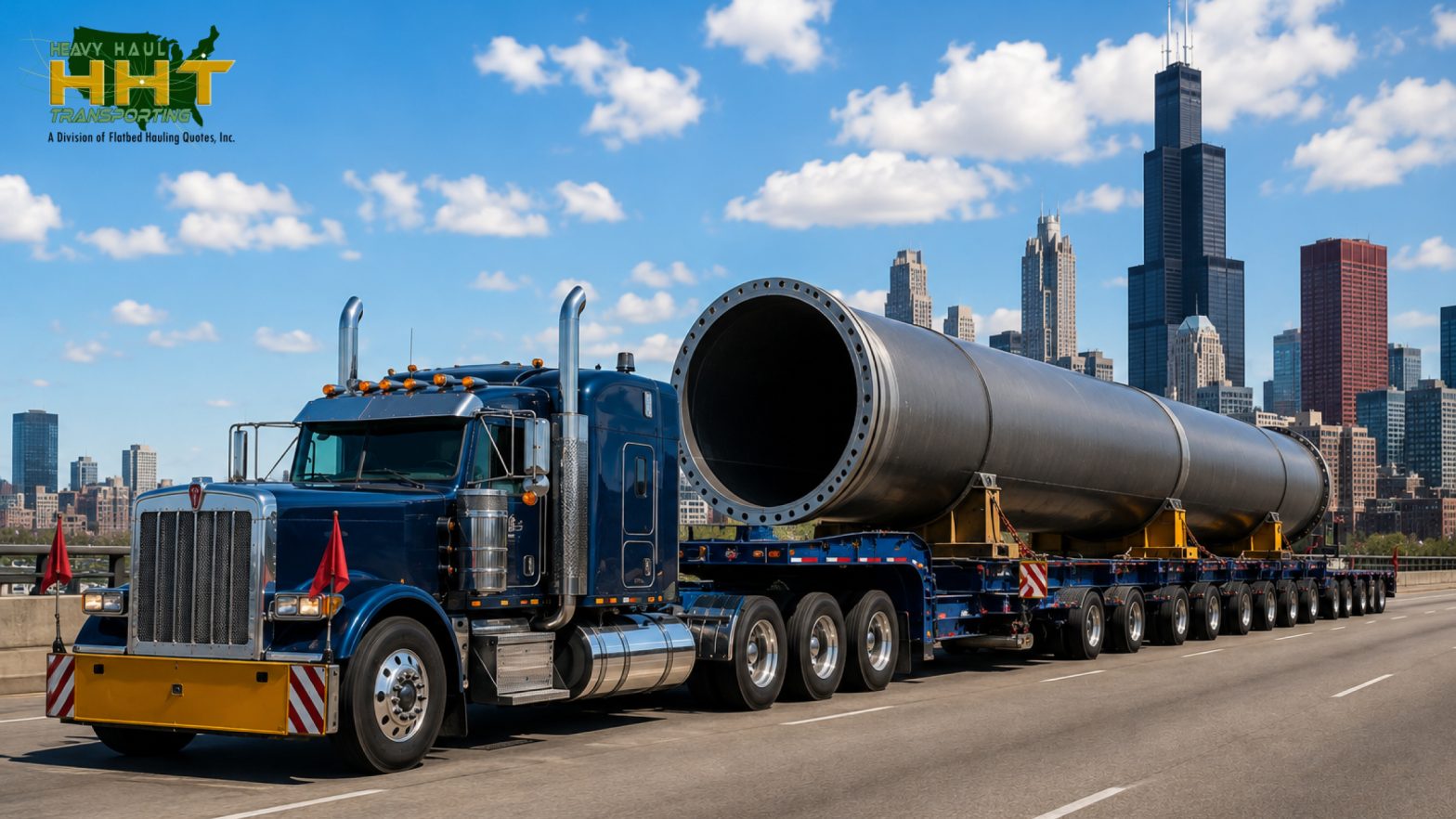
Oversized load transportation in Chicago requires an Illinois oversize/overweight permit, a compliant route plan through the city’s bridges and low clearances, and often certified escort vehicles all coordinated before the truck ever leaves the yard. Miss any one of these and the load doesn’t move, or worse, it moves illegally.
This guide breaks down every piece you need to plan a compliant, on-time oversized haul in and around Chicago.
What Counts as an Oversized Load in Chicago?
An oversized load in Chicago is any shipment that exceeds Illinois’ standard legal limits for width, height, length, or weight on public roads. Once a load crosses these thresholds, it can no longer travel without a permit.
What Are Illinois’ Standard Legal Limits?
- Width: 8 feet 6 inches
- Height: 13 feet 6 inches
- Length: 53 feet for a trailer (65 feet total combination, varies by configuration)
- Weight: 80,000 pounds gross vehicle weight on most roads
Anything beyond these numbers is classified as oversized or overweight, and Illinois issues a matching permit tier based on how far over the limit the load falls.
What Types of Freight Typically Need Oversized Hauling?
- Construction and mining equipment (excavators, cranes, dozers)
- Wind turbine blades and towers
- Manufactured or modular housing sections
- Industrial tanks, vessels, and boilers
- Agricultural equipment (combines, grain bins)
- Steel beams, girders, and precast concrete
Oversized Load Requirements Chicago Shippers Must Meet
Chicago shippers must secure a valid Illinois DOT permit, follow the state’s designated route restrictions, and meet escort vehicle thresholds before the load is legally allowed to move.
Do You Need a Permit for Every Oversized Load?
Yes, Illinois requires a permit for any load exceeding standard legal dimensions or weight, regardless of distance traveled. There is no minimum-mileage exemption, a load moving three blocks over the limit needs a permit just as much as one crossing the state.
Are There Different Permit Types?
Illinois issues several permit categories depending on load specifics:
- Single-trip permits for one-time oversized moves
- Annual permits for recurring loads within set dimension limits
- Superload permits for loads that significantly exceed standard oversize thresholds (these require individual engineering review of bridges and routes)
Oversized Load Permits Illinois: How the Process Works
Illinois oversized load permits are issued by the Illinois Department of Transportation (IDOT) and require load dimensions, weight, route, and travel dates before approval. Local municipalities like Chicago may require an additional city permit layered on top of the state permit.
Who Issues the Permit – State or City?
Both, depending on the route. IDOT covers state highways and interstates. If the route runs through Chicago city streets, the Chicago Department of Transportation (CDOT) typically requires its own local permit and may impose additional restrictions around bridges, viaducts, and downtown zones.
What Information Does the Permit Application Require?
- Exact load dimensions (length, width, height) and gross weight
- Axle configuration and spacing
- Origin and destination addresses
- Proposed route and travel dates
- Carrier’s DOT and MC numbers
How Long Does Permit Approval Take?
Standard oversize permits are often processed within 24-48 hours. Superloads or loads requiring bridge engineering analysis can take one to two weeks or longer, so these should be applied well in advance of the ship date.
Oversized Load Route Planning Chicago Carriers Rely On
Route planning for oversized loads in Chicago means identifying bridges, overpasses, and tunnels with clearance restrictions, and routing around Chicago’s dense downtown corridor whenever the load exceeds city-street tolerances. IDOT and CDOT will only approve routes that have been checked against known clearance and weight-restricted structures.
What Makes Chicago Routing Especially Difficult?
Chicago combines low-clearance viaducts, older bridge infrastructure with posted weight limits, dense downtown traffic, and active construction zones all in the same metro footprint. A route that works for a standard truck can be completely blocked for a load carrying extra height or weight.
Are There Time-of-Day or Day-of-Week Restrictions?
Oversized loads are commonly restricted from moving during weekday rush hours (typically 6-9 AM and 3-6 PM), and superloads may be limited to daylight hours only or specific overnight windows to reduce traffic conflicts. Some permits also restrict weekend or holiday travel.
Do Oversized Loads Need Escort Vehicles in Chicago?
Loads exceeding certain width, height, or length thresholds require one or more certified pilot/escort cars sometimes with front and rear escorts, and occasionally a police escort for superloads moving through dense city segments. Illinois sets specific thresholds (generally around 12-14 feet wide or above, depending on the dimension) that trigger escort requirements.
Oversized Equipment Transportation Chicago: Choosing the Right Approach
Oversized equipment transportation in Chicago works best with a carrier experienced in the specific permit and routing environment of Cook County and the surrounding highway network, not just general heavy-haul experience. Local familiarity with Chicago’s bridge restrictions and city permitting process directly affects how smoothly a move goes.
What Should You Look for in an Oversized Load Carrier?
- Active experience permitting and routing loads specifically through Chicago and Cook County
- In-house or contracted certified pilot car escorts
- A track record with your equipment type (heavy machinery, modular structures, wind components, etc.)
- Clear communication on permit timelines so you can plan ship dates realistically
What Drives the Cost of Oversized Load Hauling in Chicago?
- Permit fees (state and, if applicable, city)
- Escort vehicle requirements
- Route distance and complexity (downtown routing costs more than highway-only routes)
- Load weight and dimension tier
- Timing (rush-hour avoidance, weekend/holiday premiums)
Common Mistakes That Delay Oversized Loads in Chicago
- Applying for permits too close to the ship date, leaving no buffer for engineering review
- Assuming a state permit covers city streets without checking CDOT requirements
- Overlooking low-clearance viaducts on routes that look fine on a standard map
- Not accounting for rush-hour or downtown travel restrictions when setting delivery windows
- Failing to confirm escort vehicle certification before the load date
Frequently Asked Questions
How far in advance should I apply for an oversized load permit in Illinois?
At least one to two weeks for standard oversize loads, and up to a month for superloads that require bridge engineering review.
Can an oversized load travel through downtown Chicago?
It depends on the dimensions. Many oversized loads are routed around the downtown core entirely because of low clearances and traffic density; only loads within city-street tolerances, with proper permits, are typically approved for downtown routing.
Is a police escort required for all oversized loads?
No, Police escorts are generally reserved for superloads or moves through especially congested or sensitive segments of the city, as determined by the permit conditions.