

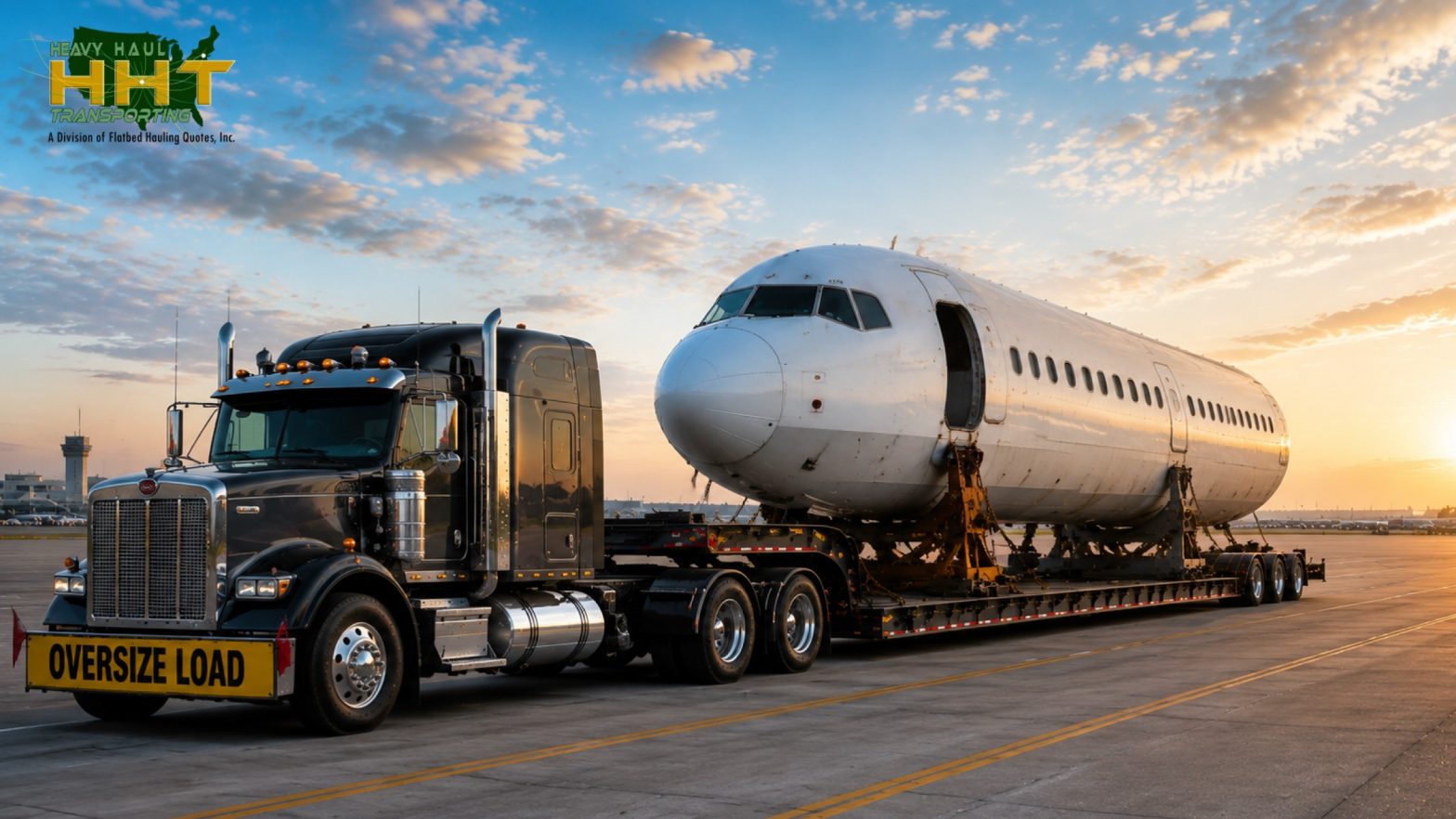
Moving a piece of heavy machinery isn’t like shipping a pallet of goods. Excavators, cranes, and bulldozers are oversized, awkward to load, and expensive to damage, which is why heavy machinery transportation relies on specialized trailers, state permits, and route planning built around each load’s exact dimensions. Get any one of those pieces wrong and you’re looking at fines, delays, or a piece of equipment that never makes it to the jobsite in one piece. Here’s what actually goes into doing it right.
What Counts as Heavy Machinery Transport?
Not every piece of equipment needs special handling. The threshold kicks in once a load’s weight, height, width, or length pushes past what a standard truck can legally carry on public roads.
Equipment That Typically Needs Special Transport
- Excavators, bulldozers, and backhoes
- Cranes and boom lifts
- Combine harvesters and tractors
- Generators and industrial compressors
- Manufacturing skids and pressure vessels
As a rough rule of thumb, most states consider a load “oversize” once it’s wider than 8.5 feet, taller than 13.5 feet, or heavier than 80,000 pounds combined. That said, the exact numbers shift depending on the state and even the specific road, so it’s worth checking rather than assuming.
Which Trailer Do You Actually Need?
This is usually the first real decision, and it comes down to how tall, heavy, and loadable your equipment is. Flatbeds handle the easy stuff. Lowboys and RGNs exist for everything else.
Flatbed Trailers
If your equipment sits under about 48,000 pounds and doesn’t have a high center of gravity, a flatbed is probably fine and it’s the cheapest option on the table. Smaller loaders and stacked materials often ship this way.
Lowboy Trailers
Once height becomes an issue, lowboys take over. The deck sits lower to the ground, which buys you the clearance a flatbed can’t. Most construction equipment in the 40,000–80,000 pound range ends up on one of these.
RGN (Removable Gooseneck) Trailers
RGN (Removable Gooseneck) Trailer are a bit different: the front detaches so equipment can be driven or winched straight onto the deck instead of using a ramp. That’s what makes them the go-to for tracked machinery like bulldozers, or anything too heavy or awkward to lift into place.
When Do You Need Escort Vehicles?
Once a load crosses certain width, height, or length thresholds, states start requiring pilot cars usually somewhere around 12 to 14 feet wide, or 14.5 feet tall, though this varies.
What Triggers What
- One pilot car – common for loads in the 12-16 foot wide range
- Front and rear escorts – kicks in once you’re past 16 feet wide, or the load is unusually long
- A height pole vehicle – used when there’s real risk of clipping a bridge or power line, since it drives ahead to check clearance
- Police escorts – reserved for superloads or routes through busy urban corridors, and only required in some states
The tricky part is that these thresholds aren’t uniform. A load that needs one escort in one state might need two by the time it crosses the border.
How Does Route Planning Actually Work?
Good route planning means mapping a path around low bridges, weight-restricted roads, and turns too tight for a long trailer to make all while working within whatever permit and time restrictions each state has in place.
What Carriers Are Actually Checking
- Bridge clearances and weight ratings along the whole route, not just the highway portions
- Active construction or closures that could block the planned path
- Turn radius at intersections – a bigger deal than people expect with long loads
- Travel-time restrictions, since a lot of states won’t allow oversize moves at night, on weekends, or around holidays
- Overhead utility lines, especially through smaller towns
Most carriers start with a digital survey of the route, then physically drive it beforehand if the load is large or complex enough to justify the extra step.
What Do You Need for an Accurate Quote?
Carriers need real numbers, not ballpark figures: exact dimensions and weight, pickup and delivery locations, and your timeline.
Dimensions and Weight
This is where a lot of quotes go sideways. A few inches or a few hundred pounds can bump you into a different trailer category, a different permit tier, or trigger an escort requirement you weren’t expecting, all of which changes the price. Measure before you call, not after.
Load Securement
Once the equipment is on the trailer, it has to be chained, blocked, and braced so it can’t shift in transit. FMCSA sets minimum tie-down requirements based on weight and length, and a carrier worth using will inspect every securement point before pulling out of the yard, not just take your word for it.
What Actually Drives the Cost?
Distance is the obvious one, but it’s rarely the whole story. Weight, dimensions, permit fees, escort requirements, and how complicated the route is all factor in.
The Big Cost Drivers
- Distance and fuel – longer hauls mean higher base mileage
- Permit fees – these stack up fast on multi-state routes
- Escort vehicles – each pilot car adds its own daily rate plus mileage
- Trailer type – RGNs generally cost more to run than a standard flatbed
- Route complexity – detours around low bridges or restricted roads eat time and miles
- Timing – rates tend to climb during peak construction and harvest season
A Few Ways to Bring the Cost Down
Flexible pickup windows help more than people expect rushing a shipment almost always costs extra. If parts of the equipment can be removed to shrink the dimensions, that’s worth considering too. And if you’re moving more than one piece to the same destination, ask about consolidating the shipment rather than booking separately.
How Do You Actually Choose a Company?
Check their DOT and MC authority, confirm real insurance coverage, and ask whether they’ve hauled your specific type of equipment before. Not every heavy haul carrier has experience with every kind of load.
A Quick Vetting Checklist
- Confirm active DOT/MC numbers through the FMCSA SAFER database
- Ask for proof of cargo insurance that actually matches your equipment’s value
- Request references from past hauls of similar equipment
- Verify they hold permits and escort partnerships in every state on your route
- Ask directly how they handle delays or damage claims – the answer tells you a lot
At Heavy Haul Transporting, Inc., we check every box on that list ourselves: we operate under USDOT# 2511472 and MC# 871067, carry full cargo insurance, and we’re a BBB-accredited transportation broker. We also don’t ask for a deposit, you shouldn’t have to put money down before your equipment is even booked.
Frequently Asked Questions
How much notice do I need to book heavy machinery transport?
For a standard haul, a few days to a week is usually enough. If your load needs multi-state permits or specialized escorts, give it at least two weeks so you’re not paying rush fees or scrambling for a slot.
Can heavy equipment be transported without taking it apart?
Most of the time, yes. That’s the whole point of lowboy and RGN trailers, they’re built to carry equipment as-is. Disassembly only really comes into play when a piece is too tall or too wide for even a lowboy deck to handle.
Does my carrier’s insurance actually cover my equipment?
It should, but don’t assume. Coverage limits vary from carrier to carrier, so confirm the policy amount actually matches or exceeds what your equipment is worth before you book.
What’s the real difference between a lowboy and an RGN?
A lowboy is a fixed low-deck trailer. An RGN’s front section detaches, so equipment can be driven straight onto the deck instead of using a ramp. RGNs tend to win out for tracked or non-drivable equipment; lowboys work fine when a ramp is an option.
Do I still need a permit if I’m only moving equipment within one state?
Yes. Permit requirements are based on the load’s size and weight, not the distance traveled. A short in-state move still needs one if the equipment is oversized.
Final Thoughts
There’s no shortcut around the fundamentals here: the right trailer, the right permits, and a route that’s actually been checked for problems before the truck leaves. Skip any of those and you’re gambling with a piece of equipment that probably cost more than the truck hauling it. Whether it’s one excavator moving across town or a multi-state relocation with several pieces involved, the difference between a smooth haul and an expensive headache usually comes down to who you hired.
Ready to move your equipment? Request a quote or call (800) 579-4258 – no deposit required, ever.