

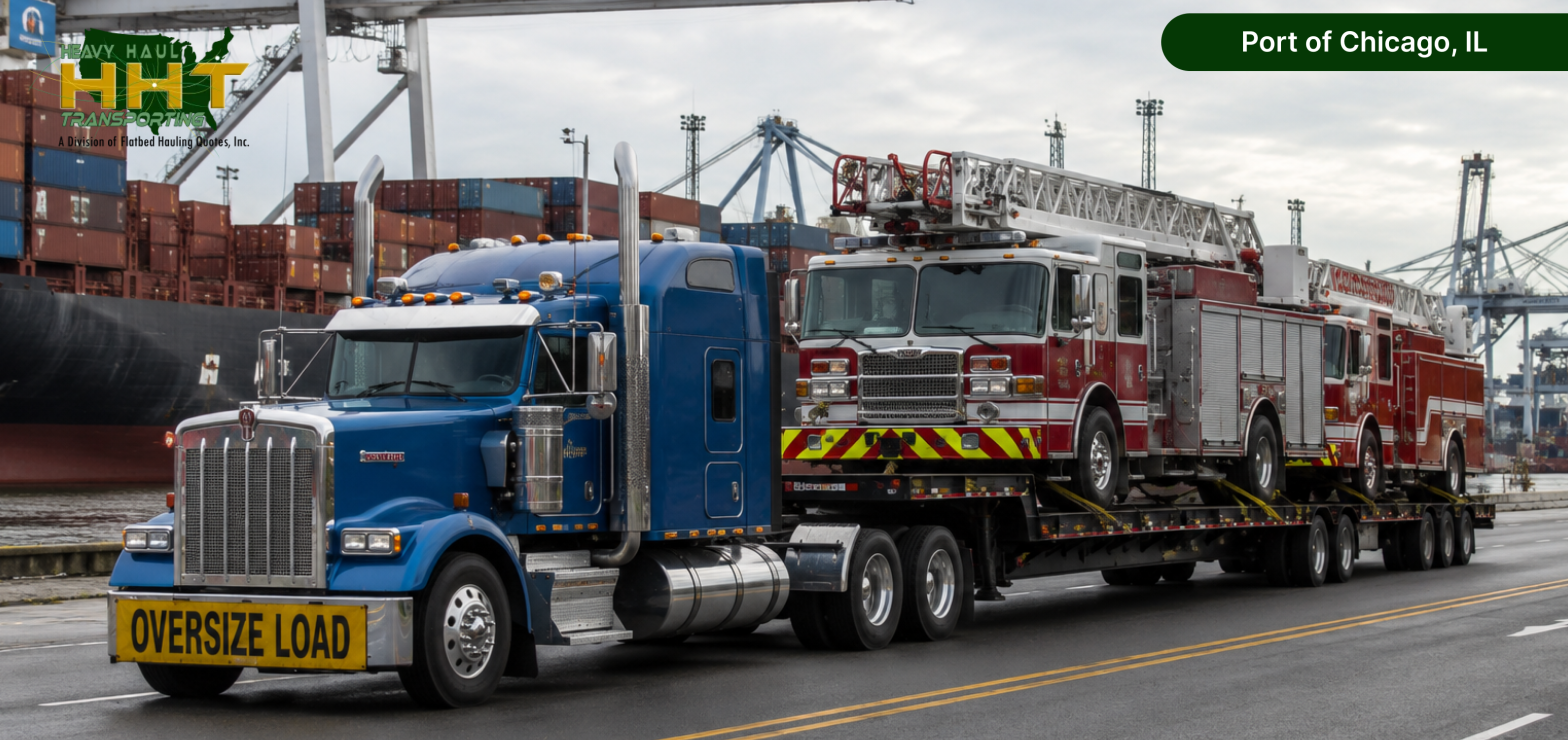
Heavy Haulers Port of Chicago, IL
Moving Oversized Freight Beyond the Port
Heavy Haulers Port of Chicago play a major role when oversized freight clears the gate and needs to move across the Midwest. At the Port of Chicago, IL, Heavy Haul Transporting helps connect port-adjacent cargo with the road network that serves manufacturing, construction, energy, and industrial buyers across the country. Chicago sits in a key position in Great Lakes commerce, and the Chicago port area supports a wide mix of cargo that often needs specialized trailers and careful route planning.
That matters because many loads cannot move like standard freight once they leave the terminal. Heavy machinery transportation, oversize load trucking, and heavy haul trucking all depend on the right equipment, the right permits, and the right route. Heavy Haul Transporting moves those loads only by road after they leave the port gate, which keeps the focus on over-dimensional hauling without crossing into loading, unloading, customs brokerage, warehousing, or freight forwarding. In a market tied to international trade, economic development, and regional manufacturing, the Port of Chicago, IL keeps generating demand for equipment transport that can handle height, width, and weight limits on Illinois roads.
Port Industries and Economic Impact
The Port of Chicago, IL supports a broad industrial base, and that is one reason Heavy Haulers Port of Chicago work stays steady throughout the year. Manufacturing plants in and around Chicago move industrial equipment, structural steel, and production machinery that often requires flatbed trucking companies and heavy equipment haulers. Construction demand also stays strong, especially for cranes, excavators, bulldozers, concrete pumpers, and modular structures headed to job sites across Illinois and neighboring states.
International trade adds another layer. Cargo tied to consumer goods transport, agricultural equipment, and energy projects can arrive in the Chicago port area and then need oversized load transport to inland destinations. Heavy equipment transportation companies often see power transformers, electrical substation modules, and large generators moving out of the region for utility upgrades and grid expansion. That same demand reaches alternative energy and solar projects, where oversized components need careful over-dimensional hauling.
The Port of Chicago, IL also supports freight linked to defense contracting, aerospace, military suppliers, and data center equipment. Those sectors often need flatbed transportation companies and heavy haul shipping companies that understand time-sensitive routing and strict dimensional limits. Heavy Haul Transporting sees that mix as a sign of a healthy freight market, because every new plant, warehouse, or infrastructure project creates more need for heavy haul transportation and oversize freight shipping.
Heavy Freight Moving Through the Port
Heavy Haulers Port of Chicago are often called when freight is too tall, too wide, or too heavy for standard transport. At the Port of Chicago, IL, common moves include construction and mining machinery, excavators, articulated dump trucks, hydraulic mining shovels, rock crushers, and tunnel boring machines. We also see industrial boilers, large metal forgings, storage silos, pre-fabricated building modules, and complete bridge sections that need careful securement before they hit the road.
Trailer selection matters just as much as the freight itself. Flatbeds work well for many steel and machinery moves, while Step Deck trailers help with taller cargo. Lowboy trailers are common for heavy equipment transportation companies handling cranes, dozers, and large generators. RGN trailers and Double Drop trailers give extra deck clearance for over-dimensional hauling, and Multi-axle trailers spread weight for the heaviest pieces. For extreme loads, Schnabel trailers can support specialized moves that require advanced planning.
Heavy Haul Transporting matches the trailer to the load, then plans the move around bridge clearances, turning radius, and Illinois road restrictions. That approach is especially important in the Port of Chicago, IL area, where freight often includes power transformers, oil and gas rig components, and aerospace or military cargo that cannot tolerate guesswork. Flatbed shippers and heavy machinery haulers both depend on that kind of planning when the load leaves the port gate and heads inland.
Transportation Challenges and Route Planning
Heavy Haulers Port of Chicago face a dense urban network, so route planning starts early. Around the Port of Chicago, IL, oversize permits in Illinois must match the exact dimensions, weight, axle spacing, and travel window for the load. State transportation regulations can also limit movement by time of day, holiday schedules, and lane restrictions, so heavy haul trucking teams need current permit details before a truck rolls.
Bridge clearances are another major issue. Chicago routes can include older structures, tight ramps, and overhead constraints that affect oversized load transport. Route surveys help identify pinch points before a load moves, especially for tall freight like electrical cabinets, cooling towers, or large telecommunication towers. Weather matters too. Wind can affect high-profile cargo, and winter conditions can slow heavy machinery transportation across the region.
Fuel prices also play a role in planning. Longer detours around congestion or clearance issues can raise operating costs, which is why heavy haul transportation requires smart routing from the start. Heavy equipment transportation companies working near the Port of Chicago, IL often build plans around I-90, I-94, I-290, and I-55 to balance access, restrictions, and traffic flow. For oversize freight shipping, that kind of preparation keeps the move practical once the load leaves the port area.
Heavy Haul Transporting provides road-only service for freight moving out of the Port of Chicago, IL and across the United States. Our fleet includes flatbeds, step decks, lowboys, RGNs, double drops, multi-axle trailers, and specialized equipment for oversized load transport. Heavy Haulers Port of Chicago rely on that trailer mix when cargo needs the right deck height, axle setup, and securement plan for the route ahead. We handle the over-the-road portion only, which means the load must already be ready to move when it leaves the port gate.
Heavy Haulers Port of Chicago support the flow of industrial freight that keeps Chicago moving, from manufacturing equipment to energy components and oversized construction cargo. The Port of Chicago, IL will keep creating demand for heavy haul trucking as infrastructure, trade, and industrial investment continue to grow. If your freight needs road transport after it clears the gate, Heavy Haul Transporting can help move it with the right trailer and route plan. For oversized freight leaving the Port of Chicago, IL, the right carrier makes every mile count.
Planning Heavy Haul Transport From Port of Chicago, IL?
Heavy Haul Transporting helps businesses coordinate the movement of oversized freight, industrial machinery, construction equipment, and project cargo throughout North America.
Primary Road Corridors Out of Port of Chicago, IL
The Port of Chicago, IL connects oversized freight to major transportation corridors across Texas and the United States. These highways are frequently used for moving construction equipment, refinery components, heavy machinery, wind energy equipment, and oversized industrial cargo after it leaves the port area.
I-90 and I-94 are two of the most important outbound corridors for the Port of Chicago, IL, and Heavy Haulers Port of Chicago use them for industrial freight headed across the metro area and beyond. Heavy Haulers Port of Chicago often move power transformers, steel fabrications, and construction equipment on these routes because they connect the Chicago port area to regional distribution points and manufacturing sites.
I-55 gives the Port of Chicago, IL a direct path toward southern Illinois and the central Midwest, which matters for Heavy Haulers Port of Chicago moving bulldozers, excavators, and modular structures. Heavy Haulers Port of Chicago use this corridor for oversized load trucking when a route needs access to industrial yards, energy projects, or construction sites with room for larger equipment.
I-290 is a key connector for the Port of Chicago, IL when freight needs to reach inner-city industrial zones, rail-adjacent business districts, and manufacturing corridors. Heavy Haulers Port of Chicago rely on this route for heavy machinery transportation, especially when moving flatbed freight like structural steel, industrial cabinets, and equipment transport loads that need careful timing through Chicago traffic.
US-41 and IL-50 help connect the Port of Chicago, IL with local industrial areas and south-side freight destinations, which is useful for Heavy Haulers Port of Chicago handling over-dimensional hauling. Heavy Haulers Port of Chicago often use these roads for flatbed trucking companies moving machinery, utility gear, and heavy equipment haulers serving construction and manufacturing customers.
Frequently Asked Questions About Port of Chicago, IL Transportation
The Port of Chicago, IL handles a variety of oversized freight, including construction equipment, wind turbine components, and heavy machinery. These items require specialized transport solutions, making Heavy Haulers Port of Chicago a key player in moving such cargo.
In Illinois, heavy hauling requires specific permits based on the dimensions and weight of the cargo. It's essential to check with local authorities for regulations. Heavy Haul Transporting can assist in navigating these requirements to ensure compliance.
For heavy loads departing from the Port of Chicago, IL, lowboy and extendable flatbed trailers are commonly used. These trailers provide the necessary support and stability for oversized cargo, ensuring safe transport to its destination.
Industries such as construction, energy, and manufacturing frequently utilize the Port of Chicago, IL for heavy haul transport. These sectors often require the movement of large equipment and materials, making heavy haulers essential for their operations.
After cargo exits the Port of Chicago, IL, it typically moves directly to its destination via designated routes. Heavy Haul Transporting coordinates logistics to ensure timely delivery, considering factors like weight limits and road conditions.
Yes, Illinois has designated routes for heavy haulers to ensure safe and efficient transport. These routes are chosen based on weight limits, road conditions, and infrastructure. Heavy Haulers Port of Chicago can provide guidance on the best routes.
Transporting heavy machinery from the Port of Chicago, IL typically requires specialized equipment like lowboy trailers and dollies. These tools ensure that the cargo is secure and can handle the weight during transit.
Absolutely! Heavy Haul Transporting specializes in managing oversized loads from the Port of Chicago, IL. Our experienced team ensures that all logistics, permits, and route planning are handled efficiently for your heavy haul needs.
NOAA Port Intelligence Related Pages
RELATED POSTS
Heavy Haulers Port of Port St. Joe and Gulf Coast freight moves
Heavy Haulers Port of Alpena Guide for Oversized Cargo Moving by Road
Heavy Haulers Port of Pascagoula Guide for Oversized Freight by Road