

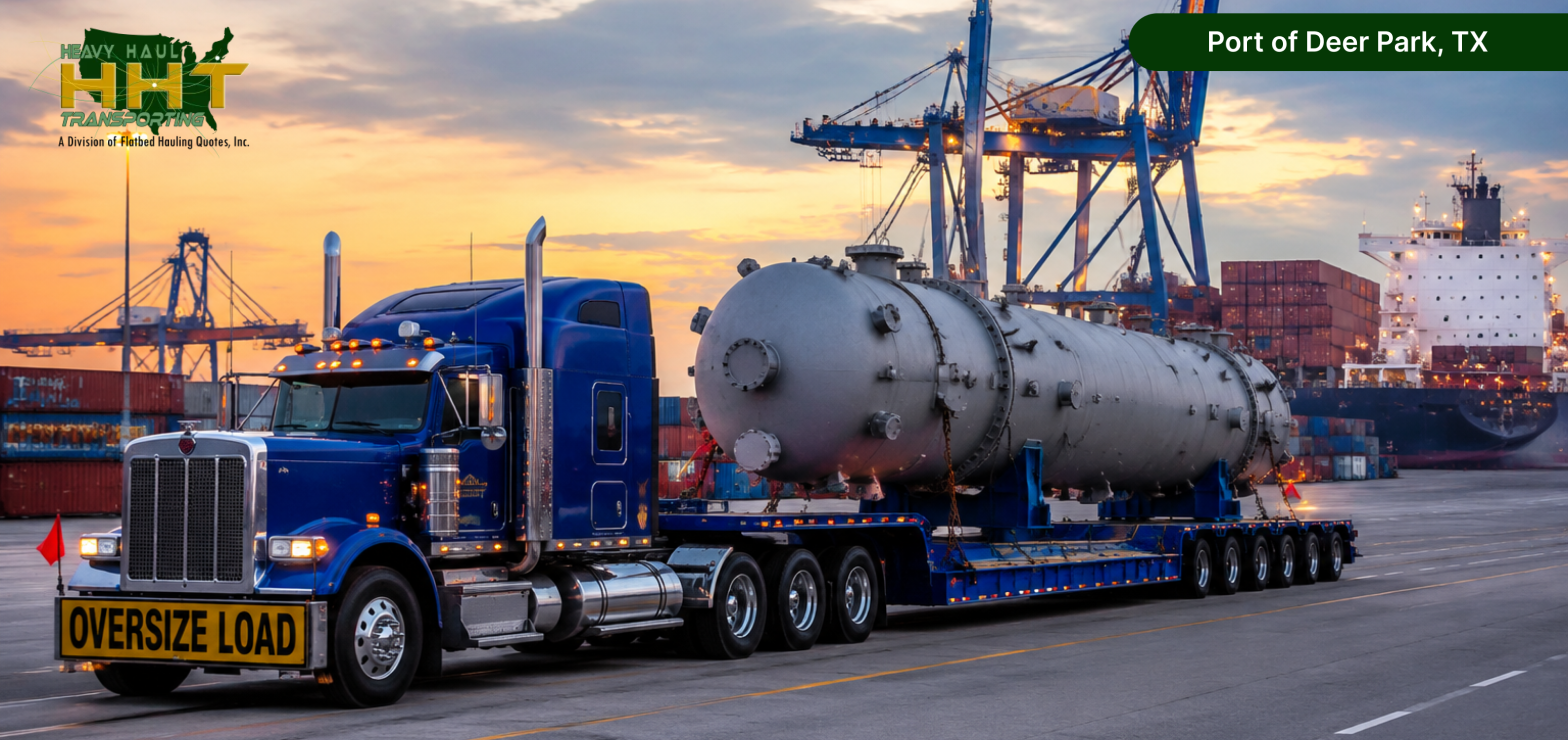
Heavy Haulers Port of Deer Park, TX
Moving Oversized Freight Beyond the Port
Heavy Haulers Port of Deer Park moves oversized freight that needs careful planning once it leaves the gate. At Port of Deer Park, TX, Heavy Haul Transporting supports over-the-road moves for cargo tied to Gulf Coast industry, where timing, route choice, and permit details matter from the first mile.
Port of Deer Park, TX sits in a busy industrial zone that connects manufacturing, refining, and energy projects to the rest of the country. That matters because oversized cargo often leaves the terminal as soon as it is ready, then needs a truck route that fits Texas weight limits, bridge clearances, and local traffic patterns. Heavy Haul Transporting handles that road-only leg after cargo clears the port area; we do not load, unload, broker customs, warehouse freight, or manage marine logistics.
The Deer Park terminal serves freight that can include refinery components, structural steel, power equipment, and construction machinery. Those loads often need Flatbed Heavy Haulers, Heavy Equipment Transport, or Oversize Load Trucking depending on size and shape. In a region shaped by international trade and Gulf Coast manufacturing, Heavy Haulers Port of Deer Park plays a practical role in moving freight from industrial yards to job sites, plants, and distribution points across the United States.
Port Industries and Economic Impact
Port of Deer Park, TX supports a freight environment shaped by oil refineries, chemical processing, manufacturing, and economic development across the Gulf Coast. That mix creates steady demand for Heavy Machinery Transportation and Equipment Transport because plants and contractors often need large components moved on tight schedules. When a project calls for transformers, tanks, skids, or modular structures, Heavy Haulers Port of Deer Park becomes part of the supply chain that keeps work moving beyond the terminal.
The Deer Park port area also connects to consumer goods transport and industrial supply chains that rely on oversized freight moving by road. Heavy equipment transportation companies often see demand here for items like industrial boilers, electrical substation modules, large generators, and structural steel beams. These loads are not simple van freight. They need flatbed trucking companies that understand load dimensions, axle spacing, and route restrictions.
Heavy haul transportation around Port of Deer Park, TX also reflects the region’s role in energy and infrastructure. Oil refineries, alternative energy projects, and offshore drilling support work can all generate freight that needs heavy equipment haulers and flatbed shippers. As projects expand, the need for oversize freight shipping grows too, especially when contractors need machinery delivered to plants, fabrication yards, or construction sites across Texas and beyond. Heavy Haulers Port of Deer Park fits that pattern by moving freight that is too large for standard trucking and too time-sensitive to sit idle.
Heavy Freight Moving Through the Port
Heavy Haulers Port of Deer Park often handles freight that demands the right trailer from the start. At Port of Deer Park, TX, that can include Construction Equipment Shipping for excavators, bulldozers, articulated dump trucks, cranes, and motor graders. It can also include energy and power freight such as power transformers, industrial boilers, large generators, and electrical cabinets. In some cases, Heavy Machinery Transportation also covers oil and gas rig components, pipe strings for pipelines, and pre-fabricated building modules.
The trailer choice matters just as much as the freight itself. Flatbeds work well for steel, pallets, and lighter industrial pieces. Step Deck trailers help with taller equipment that still needs a lower deck height. Lowboy trailers are common for taller machinery like dozers, crushers, and drilling rigs. RGN trailers and Double Drop trailers help with extra height and awkward loading geometry, while Multi-axle trailers spread weight for the heaviest pieces. For extreme loads, Schnabel trailers may be part of the plan. Heavy Haul Transporting uses these trailer types to match the load, the route, and the permit limits.
Heavy haul trucking from the Deer Park terminal also supports freight like rock crushers, tunnel boring machines, storage tanks, and complete bridge sections. That is where Oversize Equipment and Machinery Hauling Services and Flatbed Equipment Movers become part of the conversation. Heavy Haulers Port of Deer Park is built around freight that needs careful securement, clear measurements, and a truck plan that fits the load instead of forcing the load to fit the truck.
Transportation Challenges and Route Planning
Heavy Haulers Port of Deer Park has to account for Texas oversize permits before a load ever rolls out of Port of Deer Park, TX. Permit rules change with dimensions, weight, and route, so Heavy haul trucking teams need exact measurements and axle data. Weight and height restrictions can affect whether a load can use a direct path or needs a longer route with better clearances.
Bridge clearances matter a lot around the Deer Park port area, especially when a load sits high on a Step Deck or carries a tall module on a Lowboy. Route surveys help identify tight turns, utility lines, construction zones, and local restrictions before the truck moves. That planning is especially important for oversized load transport moving refinery equipment or large industrial frames through the Gulf Coast road network.
Weather also plays a role. Strong wind, rain, and sudden Gulf Coast storms can change how a tall load behaves on the road. Fuel prices matter too, since heavy haul shipping companies often build trip planning around route length, idle time, and escort needs. Heavy Haulers Port of Deer Park works best when the route fits Texas state transportation regulations and the load can move safely without surprises. That is why experienced heavy haul truckers spend time on permits, surveys, and timing before the first wheel turns.
Heavy Haul Transporting moves freight from Port of Deer Park, TX by road only, after the cargo leaves the gate and is ready for over-the-road transport. Heavy Haulers Port of Deer Park is part of our daily work, and our fleet includes Flatbeds, Step Deck trailers, Lowboy trailers, RGN trailers, Double Drop trailers, Multi-axle trailers, and Schnabel trailers for oversized freight. We focus on the trucking side of the move, not loading, unloading, customs brokerage, warehousing, or marine logistics.
Port of Deer Park, TX keeps oversized freight moving for Gulf Coast industry, and that creates steady demand for road transport after cargo clears the terminal. Heavy Haulers Port of Deer Park supports that flow with route planning, permit awareness, and trailer selection that fits the load. Heavy Haul Transporting is ready for the next move when your freight needs a truck plan built around Texas roads, not guesswork. If your project depends on oversized cargo leaving Port of Deer Park, TX and reaching its destination by road, the right heavy haul partner matters.
Planning Heavy Haul Transport From Port of Deer Park, TX?
Heavy Haul Transporting helps businesses coordinate the movement of oversized freight, industrial machinery, construction equipment, and project cargo throughout North America.
Primary Road Corridors Out of Port of Deer Park, TX
The Port of Deer Park, TX connects oversized freight to major transportation corridors across Texas and the United States. These highways are frequently used for moving construction equipment, refinery components, heavy machinery, wind energy equipment, and oversized industrial cargo after it leaves the port area.
TX-225 is one of the most important corridors for Port of Deer Park, TX because it links industrial freight to the greater Houston area and nearby manufacturing sites. Heavy Haulers Port of Deer Park often uses this route for steel, tanks, transformers, and modular equipment that need direct access to regional job sites. For oversized load transport, TX-225 matters because it can support short-haul moves where timing, lane width, and turning radius all affect the trip.
TX-134 gives Heavy Haulers Port of Deer Park another practical path for moving heavy equipment toward industrial yards and project locations around the Deer Park port area. Port of Deer Park, TX sees freight like refinery modules, industrial skids, and construction machinery that may need a route with fewer surprises and better access to local connectors. Heavy haul trucking on TX-134 often depends on exact height checks and permit routing.
SH 225 and nearby Beltway 8 connections help Port of Deer Park, TX freight reach wider Houston distribution points and contractor yards. Heavy Haulers Port of Deer Park uses these corridors for flatbed and lowboy moves carrying oversized machinery, structural steel, and power equipment. The route matters because oversize freight shipping often needs a path that avoids tight industrial bottlenecks and keeps travel time predictable.
US 90 and I-610 provide broader access for Port of Deer Park, TX freight moving into the Houston metro and beyond. Heavy Haulers Port of Deer Park relies on these routes for heavy equipment transportation companies moving cranes, generators, and large fabrication pieces. These corridors matter because they connect the Deer Park terminal to major freight lanes where bridge clearances, traffic flow, and permit timing can shape the entire move.
Frequently Asked Questions About Port of Deer Park, TX Transportation
The Port of Deer Park, TX, handles a variety of oversized freight, including industrial machinery, construction equipment, and large components for the petrochemical industry. Heavy Haulers Port of Deer Park frequently transports these items to various destinations.
In Texas, heavy hauling requires specific permits based on the dimensions and weight of your load. It's essential to check with local authorities or consult with Heavy Haul Transporting for guidance on obtaining the necessary permits for routes originating from the Port of Deer Park, TX.
For heavy loads departing from the Port of Deer Park, TX, flatbed trailers, lowboys, and step-deck trailers are commonly used. The choice depends on the cargo's dimensions and weight, ensuring safe and compliant transport.
The Port of Deer Park, TX, primarily serves the petrochemical, manufacturing, and construction industries. These sectors often require heavy hauling services for equipment and materials essential to their operations.
Once cargo exits the Port of Deer Park, TX, it is typically loaded onto specialized transport vehicles. Heavy Haul Transporting coordinates the route, ensuring compliance with local regulations and safety standards for the journey ahead.
Yes, Texas has specific route restrictions for heavy haulers, including height, weight, and width limits. It's crucial to plan your route carefully, especially when transporting oversized loads from the Port of Deer Park, TX.
When planning a heavy haul from the Port of Deer Park, TX, consider the cargo's dimensions, the required permits, and potential route restrictions. Collaborating with Heavy Haul Transporting can streamline the planning process.
To ensure cargo safety during transport from the Port of Deer Park, TX, use appropriate securing methods and choose the right trailer type. Heavy Haul Transporting provides expertise in handling oversized freight to minimize risks.
NOAA Port Intelligence Related Pages
RELATED POSTS
Heavy Haulers Port of Erie Keep Oversized Freight Moving Across Pennsylvania
Heavy Haulers Port of Houston Guide for Oversized Freight by Road
Heavy Haulers Port of Walla Walla Keep Wallula Freight Moving by Road