

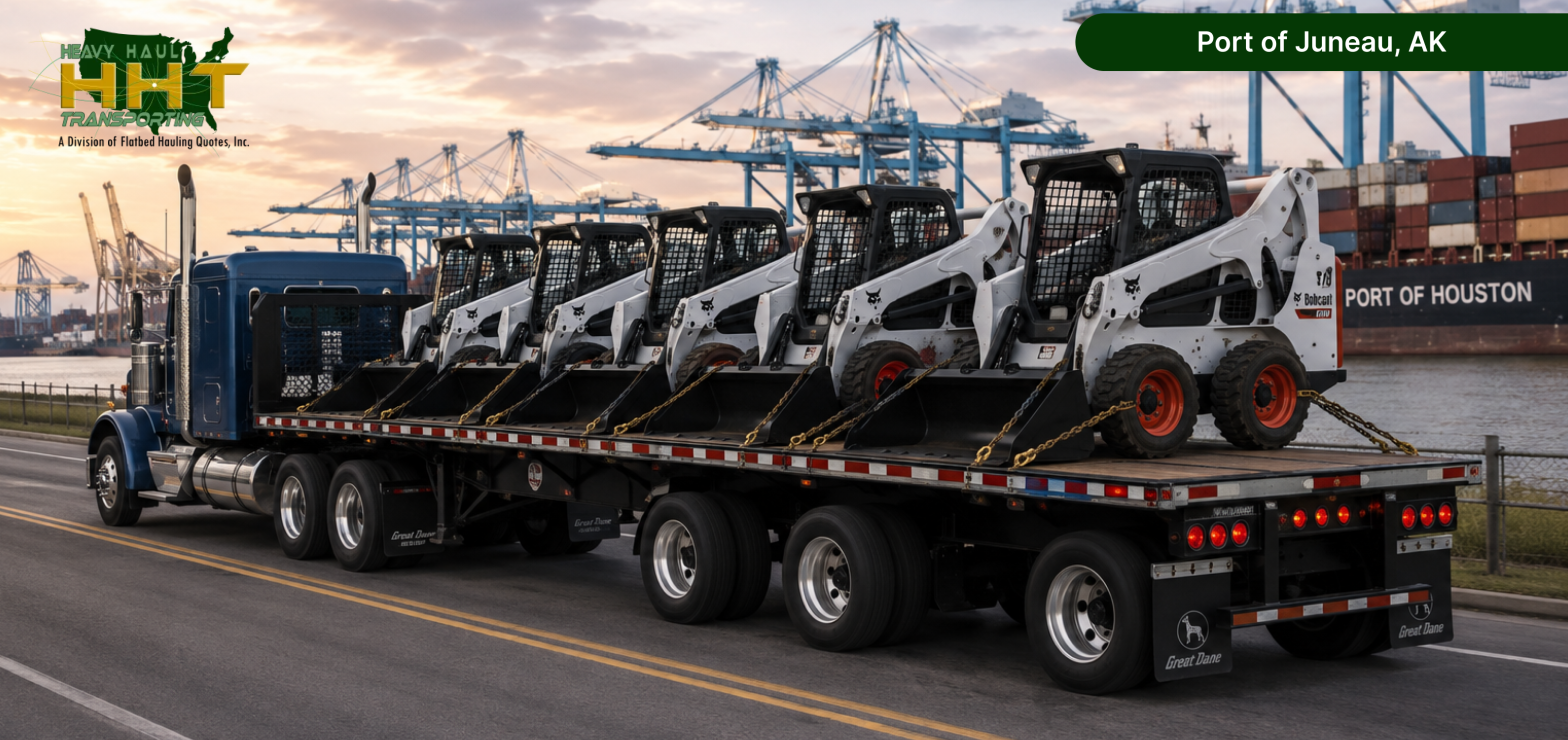
Heavy Haulers Port of Juneau, AK
Moving Oversized Freight Beyond the Port
Heavy Haulers Port of Juneau work starts with planning, timing, and a clear understanding of what can move once cargo clears the gate. At Port of Juneau, AK, Heavy Haul Transporting supports the over-the-road leg for oversized freight that serves Alaska’s construction, mining, energy, and industrial projects. The Juneau terminal matters because it connects regional demand with the broader U.S. supply chain, especially for equipment that cannot move in standard freight lanes.
Port activity in Juneau often ties into construction, economic development, manufacturing support, and utility work. That means loads can range from excavators and bulldozers to power transformers, modular structures, and industrial tanks. Heavy Haul Transporting does not handle loading, unloading, customs brokerage, warehousing, ocean freight, or freight forwarding. Our role begins after cargo leaves the port gate and needs road transport to its next stop.
That road-only handoff matters in Alaska, where route limits, weather, and permit rules can shape every move. For shippers, the challenge is not just moving a heavy load; it is moving it legally, safely, and on schedule through a state with unique transportation conditions. Heavy Haulers Port of Juneau are often called when freight must be matched to the right trailer, the right permit, and the right route.
Port Industries and Economic Impact
Heavy Haulers Port of Juneau support a mix of industries that keep the Juneau port area active year-round. Construction firms need Heavy Equipment Transport for excavators, motor graders, soil compactors, and concrete pumpers. Mining operations and resource projects create demand for Heavy Machinery Transportation, especially when oversized components, crushers, and drilling equipment must move inland after arrival at Port of Juneau, AK.
Economic development projects also drive steady demand. Modular structures, control rooms, electrical cabinets, and pre-fabricated building modules often move as oversize freight because they are too tall, wide, or long for standard trailers. In addition, utility work brings in power transformers, electrical substation modules, large generators, and cooling towers. Those loads usually require Flatbed Heavy Haulers, Flatbed trucking companies, and experienced Heavy equipment haulers who understand over-dimensional hauling rules.
The Juneau terminal also supports industrial and public-sector freight tied to defense contracting, aerospace, and energy infrastructure. Even when a project is not directly tied to a mine or refinery, it may still need Heavy haul trucking for structural steel beams, trusses, tanks, or large telecommunication towers. That is where Heavy Haulers Port of Juneau become part of the supply chain, helping move freight that supports jobs, capital investment, and long-term growth.
Because Alaska has fewer road connections than most states, each shipment needs careful planning. Oversized load transport from Port of Juneau, AK can influence project schedules, equipment availability, and fuel costs. When freight arrives in the Juneau port area, the next move often depends on the right trailer, the right permit, and a carrier that understands Heavy haul transportation in Alaska.
Heavy Freight Moving Through the Port
Heavy Haulers Port of Juneau handle a wide range of freight that does not fit standard shipping profiles. At Port of Juneau, AK, common moves include Construction & Mining Machinery, excavators, bulldozers, articulated dump trucks, hydraulic mining shovels, and mine haul trucks. We also see Energy & Power Infrastructure loads such as power transformers, industrial boilers, large generators, and electrical substation modules. For industrial clients, Heavy Haulers Port of Juneau may also move storage silos, industrial press machines, large metal forgings, and structural steel assemblies.
Trailer selection matters just as much as freight type. Flatbeds and Flatbed shippers work well for many steel and machinery loads. Step Deck trailers help with taller freight that still needs a lower deck height. Lowboy trailers are common for heavy machinery transportation, especially when height control is critical. RGN (Removable Gooseneck) trailers are useful for tracked equipment, while Double Drop trailers and Multi-axle trailers support heavier or taller cargo. For extreme moves, Schnabel trailers can handle specialized oversized load transport that demands a very specific setup.
Heavy Haul Transporting matches the trailer to the load based on dimensions, axle weights, and route limits. That matters for freight like tunnel boring machines, drilling rigs, complete bridge sections, and modular buildings. Heavy machinery haulers also need to think about tie-down points, center of gravity, and how a load will behave in wind or on grades. In Port of Juneau, AK, those details shape whether a move stays on schedule and within Alaska regulations.
Transportation Challenges and Route Planning
Heavy Haulers Port of Juneau face a different planning process than carriers working in highway-heavy markets. At Port of Juneau, AK, road access is limited, so route planning often starts with the exact destination, the load dimensions, and the permit path. Alaska oversize permits can require detailed information on width, height, length, axle spacing, and total weight. For over-dimensional hauling, that paperwork has to match the freight and the trailer before the move begins.
Weight and height restrictions matter because many loads leave the Juneau port area on routes with tight clearances and limited maneuvering room. Bridge clearances, turning radii, and shoulder conditions all affect whether a load can move without delay. Route surveys help identify pinch points before a truck rolls, especially when the shipment includes oversized equipment or tall industrial modules.
Weather is another major factor. Wind, rain, and winter conditions can change how a load handles, especially with tall freight on Step Deck trailers or wide freight on Flatbed trucking companies’ equipment. Fuel prices also affect heavy haul trucking decisions in Alaska, where longer staging, idling, and weather delays can raise operating costs quickly. State transportation regulations in Alaska add another layer, so Heavy Haulers Port of Juneau must stay current on permit windows, escort needs, and seasonal restrictions. Careful planning keeps Heavy haul shipping companies from running into avoidable delays after cargo clears Port of Juneau, AK.
Heavy Haul Transporting provides road-only service for oversized and heavy freight moving out of Port of Juneau, AK. Heavy Haulers Port of Juneau rely on our fleet of Flatbeds, Step Deck trailers, Lowboy trailers, RGN trailers, Double Drop trailers, Multi-axle trailers, and Schnabel trailers to match each load to the route and the weight profile. We focus on over-the-road transport across the United States after cargo leaves the port gate, and we do not handle marine logistics, warehousing, or customs work.
Heavy Haulers Port of Juneau play an important role in keeping Alaska projects supplied with the freight they need. At Port of Juneau, AK, demand continues to grow for Heavy equipment transportation companies, Oversize freight shipping, and Flatbed transportation companies that can manage complex loads with care. If your shipment needs road transport after it clears the gate, Heavy Haul Transporting can help plan the move with the right trailer and route strategy. Heavy Haulers Port of Juneau remain a strong fit for future construction, energy, and industrial growth in the region.
Planning Heavy Haul Transport From Port of Juneau, AK?
Heavy Haul Transporting helps businesses coordinate the movement of oversized freight, industrial machinery, construction equipment, and project cargo throughout North America.
Primary Road Corridors Out of Port of Juneau, AK
The Port of Juneau, AK connects oversized freight to major transportation corridors across Texas and the United States. These highways are frequently used for moving construction equipment, refinery components, heavy machinery, wind energy equipment, and oversized industrial cargo after it leaves the port area.
Port of Juneau, AK depends on limited road access, so freight often stages around terminal access points before moving onward by truck. Heavy Haulers Port of Juneau use this corridor planning to move excavators, modular structures, and power equipment once cargo is ready for over-the-road transport. For Heavy haul trucking, the key issue is matching load size to the available departure path and keeping the move within Alaska permit limits.
Egan Drive and Glacier Highway are important local connectors for freight leaving Port of Juneau, AK. Heavy Haulers Port of Juneau use these routes for construction equipment, industrial modules, and utility freight headed to job sites in and around Juneau. Heavy haul transportation on these roads requires attention to width, turning space, and wind exposure, especially for oversized load transport and tall flatbed freight.
When freight from Port of Juneau, AK continues through Alaska’s broader network, Seward Highway and Alaska Route 1 become key planning references for Heavy Haulers Port of Juneau. These corridors matter for Heavy machinery Transportation, power infrastructure, and large industrial loads moving toward regional distribution points. Route surveys help carriers decide whether a load can clear bridge limits and height restrictions before heavy haul shipping companies commit to the move.
Alaska Route 7 and nearby connector routes can matter for freight repositioning tied to Port of Juneau, AK, especially when equipment must move between job sites, yards, and project locations. Heavy Haulers Port of Juneau often see construction steel, tanks, and heavy machinery transportation on these segments because they support local industrial demand. For Flatbed Heavy Haulers, the focus stays on axle weight, weather, and permit timing.
Frequently Asked Questions About Port of Juneau, AK Transportation
At the Port of Juneau, AK, you can expect to see oversized freight such as construction equipment, large machinery, and specialized vehicles. Heavy Haul Transporting is experienced in managing these types of loads, ensuring they reach their destinations safely.
In Alaska, heavy haulers must obtain specific permits for oversized loads. These permits vary based on the load size and route. It's crucial to coordinate with local authorities to ensure compliance when transporting through the Port of Juneau, AK.
For heavy hauling from the Port of Juneau, AK, flatbed trailers, lowboys, and extendable trailers are commonly used. The choice depends on the dimensions and weight of the cargo. Heavy Haul Transporting can help determine the best trailer for your specific needs.
The Port of Juneau, AK, primarily serves industries like construction, mining, and tourism. These sectors often require heavy equipment and materials, making it essential for logistics managers to partner with experienced heavy haulers for efficient transport.
Once cargo leaves the Port of Juneau, AK, it typically moves directly to its destination via designated routes. Heavy Haul Transporting coordinates logistics to ensure timely delivery while adhering to local regulations and road conditions.
Yes, heavy haulers in Juneau must navigate specific route restrictions based on load size and weight. It's important to consult local regulations and plan routes accordingly to avoid delays and ensure safe transport.
Weight limits for heavy loads departing from the Port of Juneau, AK, depend on the specific routes and infrastructure. Generally, loads exceeding 80,000 pounds require special permits and route planning, which Heavy Haul Transporting can assist with.
To ensure safe transport from the Port of Juneau, AK, work with experienced heavy haulers like Heavy Haul Transporting. They provide expert guidance on route planning, permits, and equipment to minimize risks during transportation.
NOAA Port Intelligence Related Pages
RELATED POSTS
Heavy Haulers Port of Corpus Christi Guide for Oversized Freight Moves
Heavy Haulers Port of Longview Guide for Oversized Freight Moving by Road
Heavy Haulers Port of Port Townsend for Oversized Freight Moving by Road