

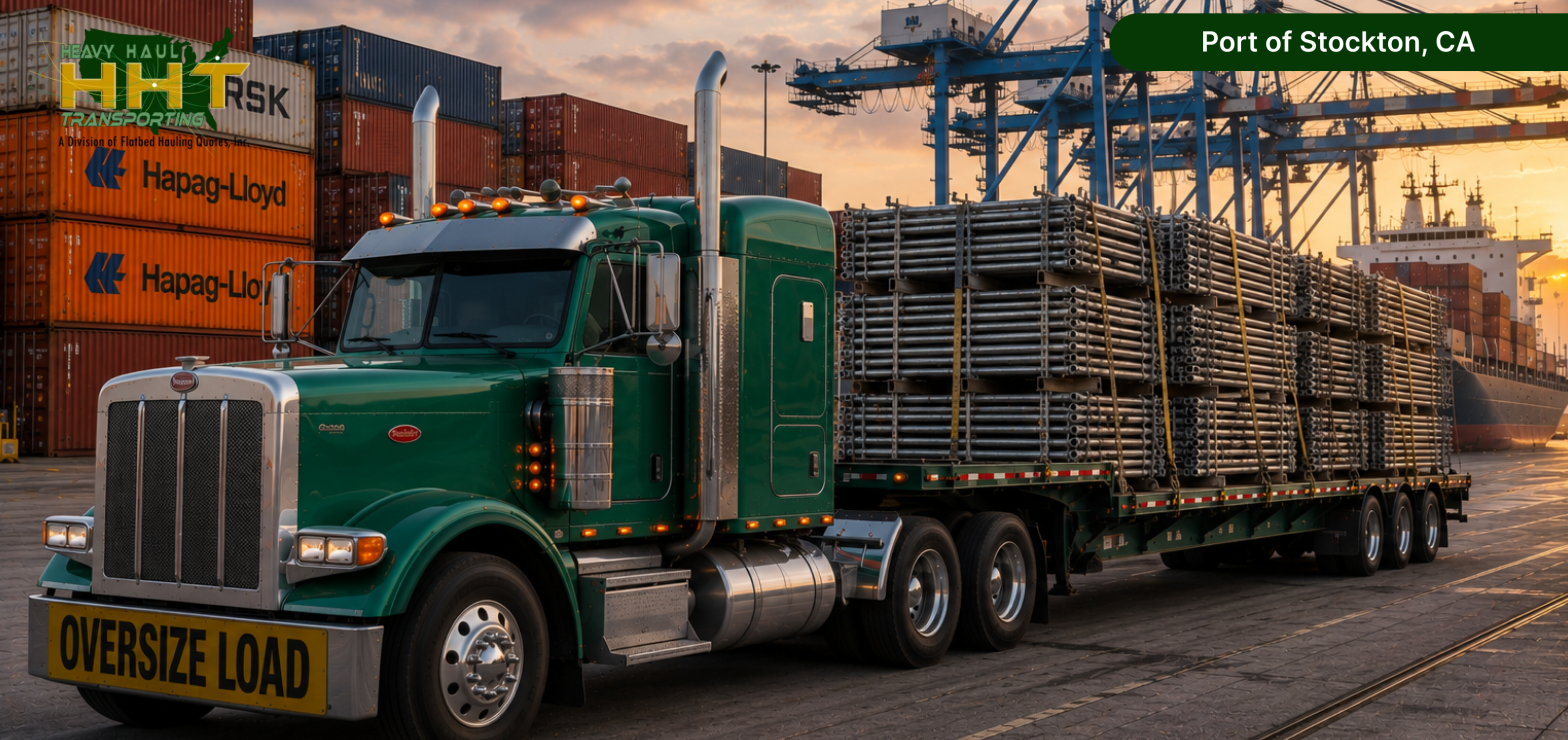
Heavy Haulers Port of Stockton, CA
Moving Oversized Freight Beyond the Port
Heavy Haulers Port of Stockton work starts where cargo leaves the gate and needs a road plan that fits California rules. Heavy Haul Transporting handles that over-the-road move from Port of Stockton, CA, connecting oversized freight to job sites, plants, and project yards across the United States. The Stockton terminal matters because it supports manufacturing, construction, agriculture, energy, and international trade moving through the Central Valley and the West Coast.
Port of Stockton, CA sees a steady mix of heavy cargo that cannot move like standard freight. Once a load clears the port area, road transport becomes the critical step for getting it to its next stop. That is where route planning, permit work, and trailer selection matter. Heavy Haul Transporting does not handle loading, unloading, customs brokerage, warehousing, ocean freight, or freight forwarding. We only move oversized and heavy freight by road after it leaves the port gate.
For shippers and project managers, that means the trucking plan has to match the load, the route, and the timing. Heavy haul trucking from Stockton often depends on bridge clearances, California oversize permits, and the right trailer for the job. When cargo is too tall, too wide, or too heavy for standard equipment, the move needs a carrier that understands the road network around the Stockton port area and the regulations that come with it.
Port Industries and Economic Impact
Heavy Haulers Port of Stockton moves are tied closely to the industries that keep this region active. Port of Stockton, CA supports manufacturing, construction, economic development, agricultural equipment, energy projects, and international trade. Those sectors create a steady need for heavy equipment transport, oversized load trucking, and heavy machinery transportation because the cargo often arrives in large, awkward, or over-dimensional pieces.
In the Stockton port area, construction firms may need excavators, bulldozers, motor graders, and concrete pumpers moved to regional jobs. Manufacturing and industrial users often ship structural steel beams, industrial boilers, large generators, and electrical substation modules. Energy and power work can bring in power transformers, gas and steam turbines, cooling towers, and large telecommunication antennas. Each of those moves adds demand for flatbed trucking companies, heavy equipment haulers, and over-dimensional hauling services.
Heavy Haulers Port of Stockton also supports freight tied to agricultural production and processing. Combine harvesters, large agricultural tractors, cotton pickers, and forestry equipment often move through the area because California’s farm economy depends on specialized machinery. That same demand shows up in consumer goods transport, modular structures, and control rooms for expanding facilities.
Port of Stockton, CA sits in a region where project schedules can shift fast. When a plant expansion, utility upgrade, or construction bid lands, shippers need flatbed transportation companies and heavy haul transportation that can respond to the freight mix. Heavy Haul Transporting sees that pattern often: the cargo may be coming through a busy seaport, but the real challenge is getting it safely onto California roads and into the inland supply chain.
Heavy Freight Moving Through the Port
Heavy Haulers Port of Stockton freight is usually the kind that needs more than a standard trailer. Port of Stockton, CA regularly connects to construction equipment shipping, industrial machinery, and oversized components that require careful trailer matching. Flatbed heavy haulers often handle I-beams, trusses, pipe strings, and smaller industrial equipment, while heavier or taller freight may call for lowboy trailers, RGN trailers, or double drop trailers.
Heavy equipment transportation companies working from Stockton often move excavators, articulated dump trucks, cranes, rock crushers, boring and drilling machines, and tunnel boring machines. Those loads can exceed normal dimensions, so heavy haul truckers use multi-axle trailers to spread weight and stay within California axle limits. For especially tall or top-heavy cargo, step deck trailers can help manage height restrictions. When the load is extreme, Schnabel trailers may be part of the plan for specialized over-dimensional hauling.
Heavy Haul Transporting also sees freight tied to power and industrial work. Large metal forgings and castings, industrial press machines, storage silos and tanks, electrical cabinets, and pre-fabricated building modules all move through the Stockton port area. Some projects involve transportation, aerospace, and military freight such as spacecraft and rocket components, armored military vehicles, or commercial aircraft fuselages and wings. Others involve oil and gas rig components, drilling rigs and masts, or large generators for utility work.
Heavy Haulers Port of Stockton shipments often need flatbed shippers who understand tie-downs, load balance, and route limits. That matters because the wrong trailer can create delays before the truck even leaves the yard. Heavy machinery haulers have to match the freight to the route, the permit, and the bridge profile, especially when the cargo is headed inland from Port of Stockton, CA.
Transportation Challenges and Route Planning
Heavy Haulers Port of Stockton planning starts with California oversize permits and the details that come with them. Port of Stockton, CA freight often needs permits for width, height, length, and weight, and those rules can change based on the route, the time of day, and the load class. Heavy haul trucking in California also has to account for escort requirements, lane restrictions, and state transportation regulations that affect over-dimensional hauling.
Bridge clearances matter a lot around Stockton because many loads leaving the Stockton port area are tall enough to create problems on secondary roads. Route surveys help identify low clearances, tight turns, utility conflicts, and pavement limits before the truck moves. Heavy equipment transportation companies use that information to decide whether a load should run on a lowboy, step deck, or multi-axle setup.
Weather also plays a role. Wind can affect tall freight like transformers, tanks, and modular structures, while rain can slow down loading windows and make route timing more sensitive. Fuel prices matter too, especially on long moves that leave Port of Stockton, CA and run toward inland California or across state lines. When diesel costs rise, project budgets feel it fast, and carriers have to plan mileage and routing carefully.
Heavy Haulers Port of Stockton work is really about reducing surprises. Heavy haul shipping companies that know the California permit process can help keep a move legal and on schedule. Heavy Haul Transporting plans each road move with the load dimensions, bridge profile, and route survey in mind so oversized load transport stays practical from the first mile after the gate.
Heavy Haul Transporting provides road-only service for Port of Stockton, CA freight that needs oversized load trucking after it clears the gate. Heavy Haulers Port of Stockton customers use our fleet for flatbed transportation companies work, heavy haul transportation, and equipment transport across the United States. Our trailer lineup includes flatbeds, step decks, lowboys, RGN trailers, double drops, multi-axle trailers, and Schnabel trailers for specialized freight.
Heavy Haulers Port of Stockton moves will keep growing as construction, manufacturing, energy, and agricultural projects keep demanding specialized freight handling. Port of Stockton, CA sits in a strong position for oversized load transport because it connects heavy cargo to California’s inland routes and national project lanes. If your freight needs a road plan after it leaves the gate, Heavy Haul Transporting can help shape the move around the load, the permit, and the route. Heavy Haulers Port of Stockton is built for the kind of freight that needs careful planning, not guesswork.
Road Corridors
I-5 Corridor
Port of Stockton, CA freight often uses I-5 for long north-south moves, and Heavy Haulers Port of Stockton shipments on this route include industrial equipment, power components, and modular structures. The corridor matters because oversized load transport from the Stockton port area can connect quickly to inland California and out-of-state project sites.
CA-99 Corridor
CA-99 is a major route for Port of Stockton, CA cargo headed into the Central Valley, and Heavy Haulers Port of Stockton carriers use it for agricultural equipment, construction machinery, and manufacturing freight. Heavy haul trucking on CA-99 matters because many loads need direct access to regional plants, farms, and job sites without unnecessary detours.
CA-4 Corridor
CA-4 gives Port of Stockton, CA freight a useful east-west link for heavy equipment transport and oversized load trucking. Heavy Haulers Port of Stockton moves on this route often include structural steel, tanks, and utility equipment, especially when the load needs to reach Delta-area projects or connect to other state highways.
I-205 and CA-120 Corridor
For Port of Stockton, CA shipments, I-205 and CA-120 help move heavy machinery transportation toward the broader Northern California network. Heavy Haulers Port of Stockton uses these corridors for flatbed heavy haulers work, especially when freight includes excavators, generators, or industrial machinery that needs a clean route out of the Stockton port area.
Planning Heavy Haul Transport From Port of Stockton, CA?
Heavy Haul Transporting helps businesses coordinate the movement of oversized freight, industrial machinery, construction equipment, and project cargo throughout North America.
Primary Road Corridors Out of Port of Stockton, CA
The Port of Stockton, CA connects oversized freight to major transportation corridors across Texas and the United States. These highways are frequently used for moving construction equipment, refinery components, heavy machinery, wind energy equipment, and oversized industrial cargo after it leaves the port area.
Port of Stockton, CA freight often uses I-5 for long north-south moves, and Heavy Haulers Port of Stockton shipments on this route include industrial equipment, power components, and modular structures. The corridor matters because oversized load transport from the Stockton port area can connect quickly to inland California and out-of-state project sites.
CA-99 is a major route for Port of Stockton, CA cargo headed into the Central Valley, and Heavy Haulers Port of Stockton carriers use it for agricultural equipment, construction machinery, and manufacturing freight. Heavy haul trucking on CA-99 matters because many loads need direct access to regional plants, farms, and job sites without unnecessary detours.
CA-4 gives Port of Stockton, CA freight a useful east-west link for heavy equipment transport and oversized load trucking. Heavy Haulers Port of Stockton moves on this route often include structural steel, tanks, and utility equipment, especially when the load needs to reach Delta-area projects or connect to other state highways.
For Port of Stockton, CA shipments, I-205 and CA-120 help move heavy machinery transportation toward the broader Northern California network. Heavy Haulers Port of Stockton uses these corridors for flatbed heavy haulers work, especially when freight includes excavators, generators, or industrial machinery that needs a clean route out of the Stockton port area.
Frequently Asked Questions About Port of Stockton, CA Transportation
The Port of Stockton, CA handles a variety of oversized freight, including construction equipment, industrial machinery, and large components for renewable energy projects. Heavy Haulers Port of Stockton frequently transports these types of cargo to various destinations.
In California, heavy hauling requires specific permits based on the load size and route. It's essential to check with local authorities for any restrictions or requirements. Heavy Haul Transporting can assist with the permit process for routes originating from the Port of Stockton, CA.
For heavy loads departing from the Port of Stockton, CA, lowboy and flatbed trailers are commonly used. These trailers provide the necessary support and stability for oversized cargo, ensuring safe transport to its final destination.
The Port of Stockton, CA serves various industries, including agriculture, construction, and energy. Each of these sectors often requires heavy hauling services for transporting large equipment and materials essential for their operations.
Once cargo exits the Port of Stockton, CA, it is typically transported directly to its destination via truck. Heavy Haul Transporting coordinates the logistics to ensure timely delivery while adhering to all road regulations.
Yes, California has specific route restrictions for heavy haulers, especially on certain highways and bridges. It's crucial to plan routes carefully to avoid restricted areas, especially when transporting from the Port of Stockton, CA.
Heavy hauling from the Port of Stockton, CA requires specialized equipment such as heavy-duty trucks and trailers designed for oversized loads. This equipment ensures that cargo is transported safely and efficiently.
To track your heavy haul shipment from the Port of Stockton, CA, stay in contact with Heavy Haul Transporting. They provide updates and tracking information to ensure you know the status of your cargo at all times.
NOAA Port Intelligence Related Pages
RELATED POSTS
Heavy Haulers Port of Portland Guide for Oversized Freight Moving by Road
Heavy Haulers Port of Ashland Keep Oversize Freight Moving Across Wisconsin
Heavy Haulers Port of Homer Keep Oversize Freight Moving Across Alaska Roads