

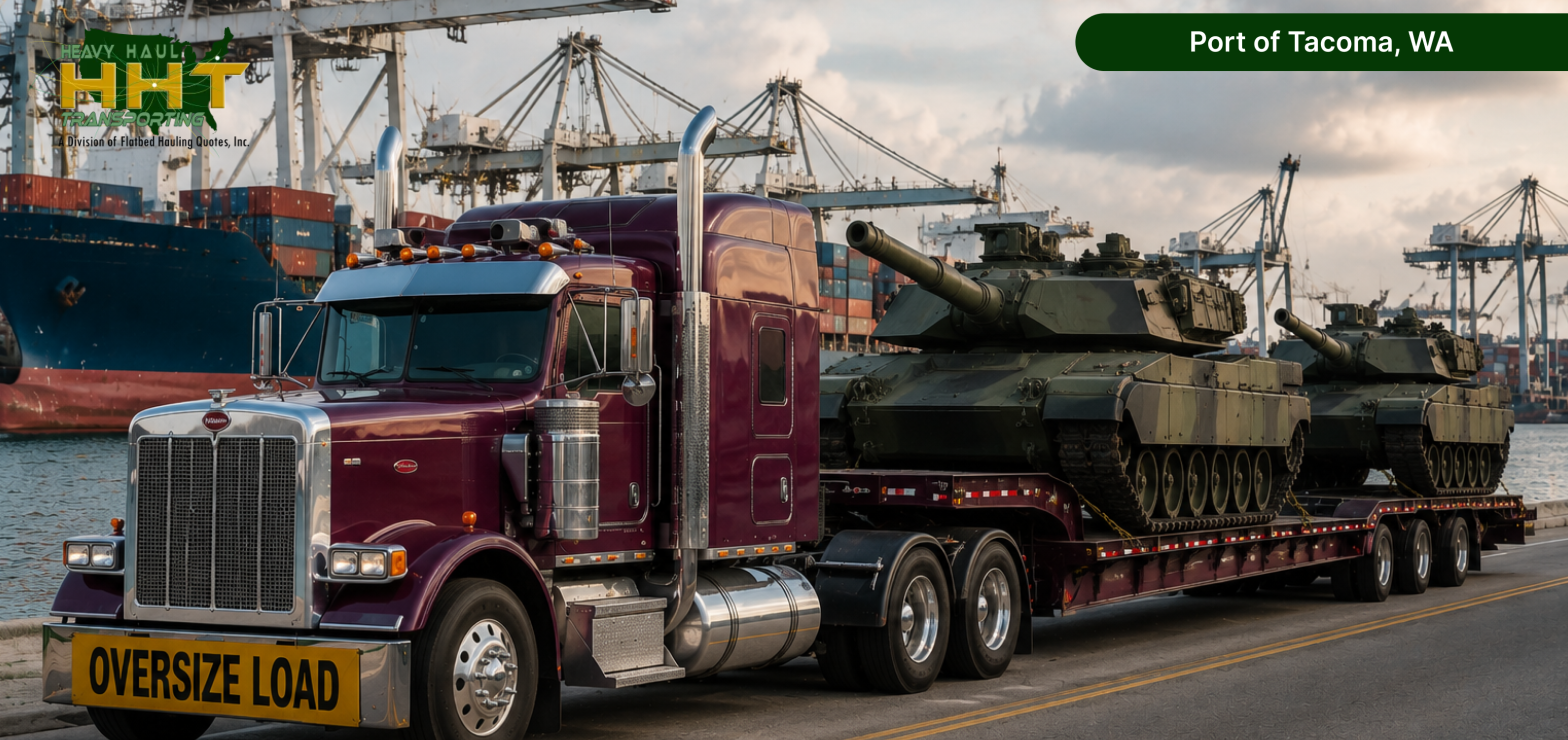
Heavy Haulers Port of Tacoma, WA
Moving Oversized Freight Beyond the Port
Heavy Haulers Port of Tacoma moves when oversized freight clears the gate and needs a road plan that fits Washington traffic, bridge limits, and permit rules. At the Port of Tacoma, WA, Heavy Haul Transporting handles over-the-road moves for cargo that supports manufacturing, construction, energy, defense, and international trade across the West Coast and beyond.
The Tacoma terminal sits inside one of the busiest trade corridors in the region, so the freight mix changes fast. One day it may be industrial equipment, and the next it may be structural steel, power components, or modular units headed to a jobsite. That kind of cargo does not move well on standard trucks, which is why heavy haul trucking matters after the load leaves the port gate.
Heavy Haul Transporting focuses only on road transport throughout the United States. We do not load or unload port cargo, handle customs brokerage, provide warehousing, or manage ocean freight. Our role starts once the shipment is ready to roll out of the Tacoma port area and onto a permitted route. For shippers, contractors, and project managers, that means one thing: the move has to be planned around size, weight, route restrictions, and timing from the start.
Port Industries and Economic Impact
The Port of Tacoma, WA supports a wide range of industries that depend on oversized freight moving by road. Manufacturing plants need heavy machinery transportation for presses, tanks, and production lines. Construction firms rely on heavy equipment transport for excavators, cranes, graders, and compactors. Energy projects also create steady demand for heavy equipment transportation companies because transformers, generators, and substation modules often exceed normal legal dimensions.
Heavy Haulers Port of Tacoma is especially relevant when project cargo has to move quickly from a marine terminal into inland work zones. That includes freight tied to alternative energy, solar, fossil fuel, defense contracting, aerospace, and data center equipment. A single project may require flatbed trucking companies for steel and packaged machinery, then switch to over-dimensional hauling for larger pieces that need a lowboy or multi-axle setup.
International trade also drives the need for heavy haul transportation in Tacoma. Imported industrial equipment, consumer goods transport assets, and specialized components often arrive in sizes that require flatbed shippers and heavy equipment haulers to coordinate the next leg. In the same way, export cargo leaving the Tacoma port area may include pre-fabricated building modules, large generators, or industrial boilers that need oversized load transport to reach a staging yard, plant, or construction site.
Because the region serves both local industry and national supply chains, Heavy Haulers Port of Tacoma work is tied directly to economic development. When projects grow, so does the need for flatbed transportation companies, heavy haul shipping companies, and oversize freight shipping that can keep large freight moving on schedule.
Heavy Freight Moving Through the Port
Heavy Haulers Port of Tacoma often handles freight that is too tall, too wide, or too heavy for standard transport. In the Tacoma port area, that can include construction and mining machinery, excavators, bulldozers, articulated dump trucks, mobile and crawler cranes, hydraulic mining shovels, and tunnel boring machines. It can also include structural steel beams, complete bridge sections, large generators, industrial boilers, and electrical substation modules.
For that kind of work, trailer choice matters. Flatbeds work well for many palletized or oversized pieces, while step deck trailers help with extra height. Lowboy trailers are common for taller equipment like dozers and cranes, and RGN trailers make loading easier for tracked machinery. Double Drop trailers help with height-sensitive freight, multi-axle trailers spread weight for heavier pieces, and Schnabel trailers can support extreme loads when the project calls for it.
Heavy Haul Transporting uses that trailer mix to match the freight, not force the freight to fit the trailer. That is important for heavy machinery haulers moving industrial press machines, large metal forgings, storage silos, cooling towers, or pre-fabricated building modules. It also matters for transportation, aerospace, and military freight such as spacecraft components, armored vehicles, or large aircraft sections.
Heavy Haulers Port of Tacoma moves are rarely simple point A to point B trips. They often require load securement planning, axle spacing checks, and route timing that fits local traffic patterns. The right equipment transport setup keeps the move legal and practical once the load leaves the Tacoma terminal.
Transportation Challenges and Route Planning
Heavy Haulers Port of Tacoma planning starts with Washington oversize permits, because permit limits change with load width, height, length, and gross weight. A move that looks straightforward on paper can still run into bridge clearances, turning radius issues, or seasonal restrictions once it reaches the street network around Tacoma. That is why route surveys matter before the truck ever rolls.
Heavy haul trucking in Washington also has to account for weather. Rain, wind, and slick pavement can affect braking distance and trailer control, especially on taller loads. Fuel prices matter too, because long route miles and multi-axle setups can change operating costs fast. For oversized load transport, even a small detour can affect timing and budget.
At the Port of Tacoma, WA, our planning also follows state transportation regulations that govern escorts, signage, lighting, and travel windows. Weight and height restrictions can vary by corridor, so a route that works for one piece of equipment may not work for another. That is common with heavy equipment haulers moving power transformers, industrial boilers, or large fabrication pieces.
Heavy Haulers Port of Tacoma moves often depend on the details: bridge decks, overhead utilities, lane widths, and local construction zones. Flatbed heavy haulers may have more flexibility on some moves, but oversized freight shipping still needs a clean route plan. When the load is tall or wide, the safest path is usually the one that has already been surveyed and approved.
Heavy Haul Transporting provides road-only service for oversized and heavy freight leaving the Port of Tacoma, WA. We do not handle port loading, unloading, customs, warehousing, or freight forwarding. Instead, our fleet is built for over-dimensional hauling with flatbeds, step decks, lowboys, RGNs, double drops, multi-axle trailers, and specialized equipment for complex moves.
Heavy Haulers Port of Tacoma shipments often need that kind of trailer range because the cargo changes from one project to the next. Our drivers coordinate with permit requirements, route limits, and delivery timing so the load can move legally once it exits the Tacoma port area.
Heavy Haulers Port of Tacoma keeps Washington projects moving by connecting industrial cargo, construction equipment, and energy freight to the roads that carry them inland. The Port of Tacoma, WA will keep generating demand for oversized load transport as trade, manufacturing, and infrastructure work continue to grow.
If your next move needs careful route planning and the right trailer match, Heavy Haul Transporting is ready to handle the road portion after the cargo clears the gate. Heavy Haulers Port of Tacoma work takes experience, permit knowledge, and a trailer plan that fits the freight.
Planning Heavy Haul Transport From Port of Tacoma, WA?
Heavy Haul Transporting helps businesses coordinate the movement of oversized freight, industrial machinery, construction equipment, and project cargo throughout North America.
Primary Road Corridors Out of Port of Tacoma, WA
The Port of Tacoma, WA connects oversized freight to major transportation corridors across Texas and the United States. These highways are frequently used for moving construction equipment, refinery components, heavy machinery, wind energy equipment, and oversized industrial cargo after it leaves the port area.
I-5 is the main north-south freight spine for the Port of Tacoma, WA, and Heavy Haulers Port of Tacoma moves often use it to reach Seattle, Olympia, and inland distribution points. Heavy haul trucking on I-5 commonly carries industrial machinery, steel, generators, and construction equipment because the corridor connects the Tacoma port area to major job markets and manufacturing sites.
SR-16 matters for the Port of Tacoma, WA because it links the Tacoma port area to the Kitsap side and to key connections around the city. Heavy Haulers Port of Tacoma shipments on this route often include oversized load transport for modular structures, heavy equipment transport, and project cargo that needs a direct path away from port congestion.
SR-509 gives the Port of Tacoma, WA a useful freight connection for moves that need to avoid heavier traffic on the main city streets. Heavy Haulers Port of Tacoma loads on SR-509 often include flatbed trucking companies’ freight such as structural steel, industrial equipment, and oversized freight shipping that can benefit from a more controlled route out of the Tacoma port area.
SR-167 helps connect the Port of Tacoma, WA to the Kent Valley and south Puget Sound industrial zones. Heavy Haulers Port of Tacoma freight on this corridor often includes heavy machinery transportation, equipment transport, and flatbed shippers’ cargo such as excavators, tanks, and power components headed to warehouses, plants, or construction sites.
Frequently Asked Questions About Port of Tacoma, WA Transportation
The Port of Tacoma, WA, handles a variety of oversized freight, including heavy machinery, construction equipment, and large industrial components. Heavy Haulers Port of Tacoma specializes in transporting these large items efficiently to their final destinations.
In Washington, oversized loads typically require special permits for transport. It's essential to check with the Washington State Department of Transportation for specific regulations. Heavy Haulers Port of Tacoma can assist you with the necessary permits and route planning.
For heavy hauling from the Port of Tacoma, WA, lowboy trailers and flatbed trailers are commonly used. These trailers provide the necessary support and stability for oversized loads, ensuring safe transport to their destination.
The Port of Tacoma, WA, serves various industries, including construction, manufacturing, and energy. Heavy Haul Transporting frequently collaborates with these sectors to move large equipment and materials efficiently.
Once cargo exits the Port of Tacoma, WA, it is loaded onto specialized transport vehicles. Heavy Haul Transporting coordinates the logistics to ensure timely delivery, considering factors like route restrictions and load dimensions.
Yes, there are designated routes for heavy haulers leaving the Port of Tacoma, WA. These routes are planned to accommodate oversized loads and avoid low bridges or narrow roads, ensuring safe and efficient transport.
Safety measures for heavy hauling from the Port of Tacoma, WA, include using appropriate escort vehicles, adhering to speed limits, and ensuring proper load securing. Heavy Haul Transporting emphasizes safety throughout the transport process.
Yes, Heavy Haul Transporting can accommodate last-minute requests for heavy hauling from the Port of Tacoma, WA. Our team is experienced in quickly organizing logistics to meet urgent shipping needs.
NOAA Port Intelligence Related Pages
RELATED POSTS
Heavy Haulers Port of Savannah Guide for Oversized Freight Moving by Road
Heavy Haulers Port of Hilo Guide for Oversized Freight Moving Across Hawaii
Heavy Haulers Port of Aguadilla Keep Oversized Freight Moving Across Puerto Rico