

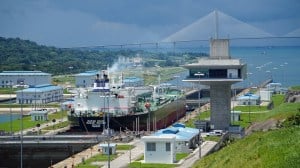
The Panama Canal Authority will increase the number of daily Neopanamax-lock transits to 10 beginning Oct. 15, lifting total daily capacity across the Neopanamax and Panamax locks to 33 slots as water conditions improve, the authority said Tuesday.
The increase is based on present and projected Gatun Lake levels, following near-average rainfall in the canal watershed and water-conservation measures at the locks.
The authority also said, effective immediately, it has restored the maximum authorized draft for Neopanamax vessels to 49 feet.
The new allocation marks the Canal’s most recent easing of drought-related operating restrictions. The authority previously reduced daily transit capacity and imposed draft limits as a prolonged water shortage lowered Gatun Lake, the principal reservoir supplying water to the locks.
The change matters for ports such as New York-New Jersey, Norfolk, Savannah, Charleston, Miami, Houston and New Orleans, where delayed canal passages can cascade into late berth arrivals, disrupted rail connections, chassis imbalances and unpredictable terminal workloads. The prior cuts reduced total daily capacity to as few as 32 ships in mid-September.
The immediate draft increase lets ships carry more cargo through the canal. A 10,000-TEU containership can lose roughly 450 TEUs of carrying capacity for every foot of draft restriction, according to one industry estimate.
Despite the added capacity and deeper draft allowance, the authority said the watershed remains in deficit and cautioned that its transit reservation, or booking, system is still the only means of guaranteeing a crossing date. Vessels arriving without a reservation could face indefinite delays.
Read more articles by Stuart Chirls here.
Read more:
Suez return speeds up Savannah India service by 10-14 days
No mention of U.S.-China ship taxes in trade truce
Hapag-Lloyd revises Zim offer as Israeli approval concerns persist
But no pandemic high: Asia-US container rate at $9,600
New data shows Suez route transits rose 27% in August
The post New limits: More ships can transit this key cargo chokepoint appeared first on FreightWaves.