

This week’s report is about reversals. Mexico Crossings through South Texas flipped from Slight Shortage of capacity back to Slight Surplus in a single week, undoing last week’s tightening and pushing rates down or flat on most of its lanes. Santa Maria’s Atlanta lane, which spiked +47% last week and drew a DAT iQ cross-check flag, corrected hard at -22% this week — confirming that move was a one-week anomaly, not the start of a trend.
Get the clearest, most accurate view of the truckload marketplace with data from DAT iQ.
Tune into DAT iQ Live, live on YouTube or LinkedIn, 10am ET every Tuesday.
Yakima Valley loosened from Slight Shortage to Adequate as Washington cherry and stone fruit volumes build. Georgia’s Shortage designation held for a sixth-plus straight week, but every outbound lane eased 7%-13%, suggesting the market is absorbing the tightness rather than escalating on top of it.
The one lane bucking the relief theme: California South & Central District citrus — still Slight Shortage as the navel orange close continues — where the Seattle lane jumped +22%, a move we’re flagging for DAT iQ cross-check.
Mexico crossings through South Texas: The big flip
South Texas moved from Slight Shortage to Slight Surplus this week — the second availability flip here in as many reports. The Boston lane, which had plateaued at elevated levels after a prior spike, broke that plateau to the downside, dropping -8%. Most of the basket (asparagus, broccoli, carrots, peppers, tomatoes, watermelons) eased or held flat.
Santa Maria, California: Anomaly confirmed, rates snap back
Last week’s Santa Maria → the Atlanta spike (+47%) appears to be a one-off after this week’s -22% correction: the lane gave back essentially the entire move. The rest of the Santa Maria basket (broccoli, cauliflower, celery, lettuce varieties, strawberries) eased across the board, with Dallas and Seattle the only lanes moving higher.
Yakima Valley, Washington: Cherry season loosens the market
Yakima moved from Slight Shortage to Adequate as apple, blueberry, cherry, pear, and rhubarb volumes build with the season. Most lanes eased or held flat; USDA did not report a comparable change for the Baltimore lane this week.
Georgia: Shortage persists, but pressure is easing
Georgia (including West and North Florida volume) remains under a full Shortage designation on tomatoes and watermelons. That said, every outbound lane eased this week, with declines ranging from -7% to -13% — a sign the market is digesting the tightness rather than piling on.
California citrus: Navel orange close keeps pressure on
The South & Central California District’s grapefruit, lemon, and orange basket remains under its own Slight Shortage designation, distinct from the district’s broader Adequate vegetable rating — this is the navel orange close, not a citrus-wide exit; valencias and lemons continue into summer. Most lanes eased or were mixed, but Seattle jumped +22%, the sharpest single-lane move in the citrus basket this week.
California vegetable belt: Steady as she goes
The rest of California’s coastal and desert vegetable districts stayed Adequate and mostly quiet. South & Central District’s general basket (anise, artichokes, avocados, broccoli, leafy greens, radishes, spinach) eased on most lanes but jumped +8% into Chicago. Salinas-Watsonville was essentially flat. Kern’s carrot lanes and Oxnard’s celery/greens/strawberries basket both eased.
Imperial/Coachella Valleys, CA & Central-Western Arizona
This basket (anise, artichokes, leafy greens, celery, and more via Mexico crossings through Calexico and San Luis) eased on most lanes, with New York and Atlanta down double digits.
Nogales, Arizona & Vidalia, Georgia: Quiet corners
Mexico crossings through Nogales carried only mango volume this week, with a $1,500–$1,700 range into Los Angeles and no comparable change reported. Vidalia’s dry onion basket held completely flat across every one of its nine lanes for another week — a steady baseline in an otherwise moving market.
What this means for carriers, shippers & brokers
For Carriers: South Texas’s flip back to Slight Surplus means less pricing leverage there than a week ago — reposition toward Yakima Valley and Georgia, where availability is still tighter and rates, while easing, remain elevated relative to the surplus lanes. The Santa Maria correction is a reminder not to chase single-week spikes; wait for a second data point before committing capacity based on one outlier lane.
For Shippers: Georgia’s continued Shortage designation means budgeting for premium rates out of that region for at least another week, even as the rate of increase slows. California’s general vegetable basket remains your most stable, lowest-volatility sourcing option right now.
For Brokers: Watch the California citrus → Seattle lane (+22%) closely — cross-check as a newer move that hasn’t yet been confirmed as a trend or a one-off, unlike the Santa Maria spike, which was resolved this week. Keep an eye on South Texas in the coming reports; a second flip back to Slight Shortage would be the more important story than this week’s move alone.
National reefer market spot rate analysis
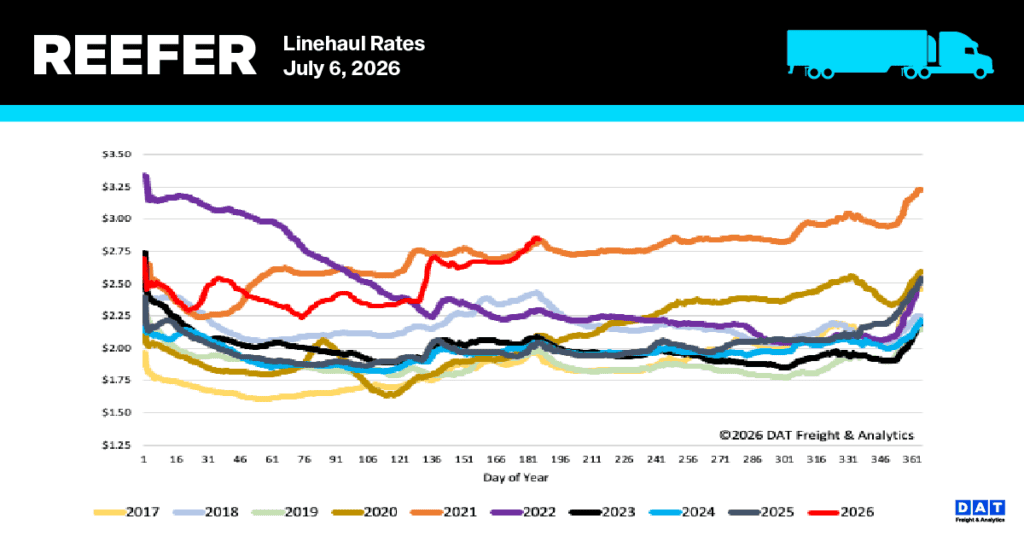
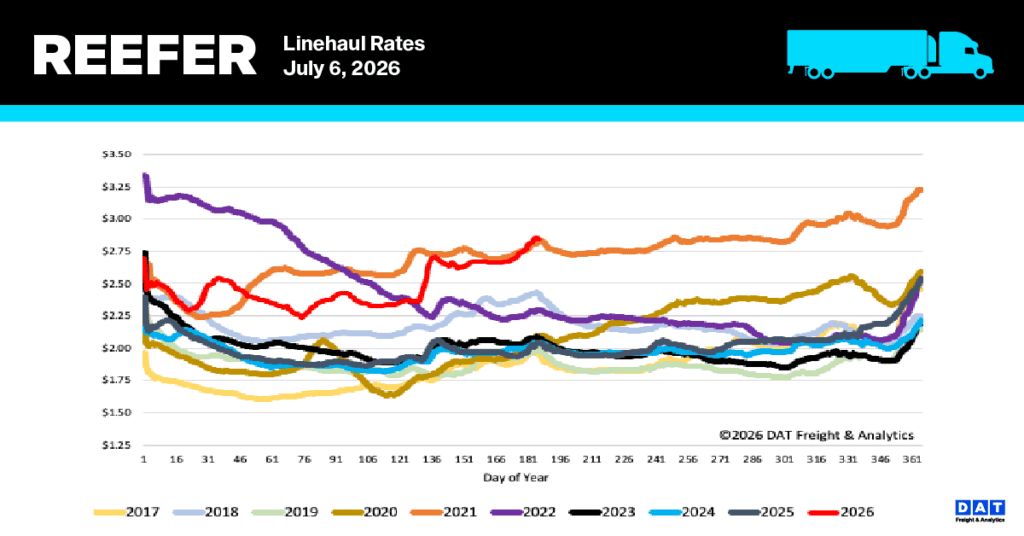
For the first time in many years, the market saw a produce season in terms of the typical July 4 spike in reefer rates. Over the last 10 years the produce season, defined by the Vidalia Onion pack date in mid-April to July Fourth, reefer linehaul rates have averaged an increase of $0.23 per mile. This season, reefer linehaul rates more than doubled that long-term average, jumping by $0.50 per miles over produce season.
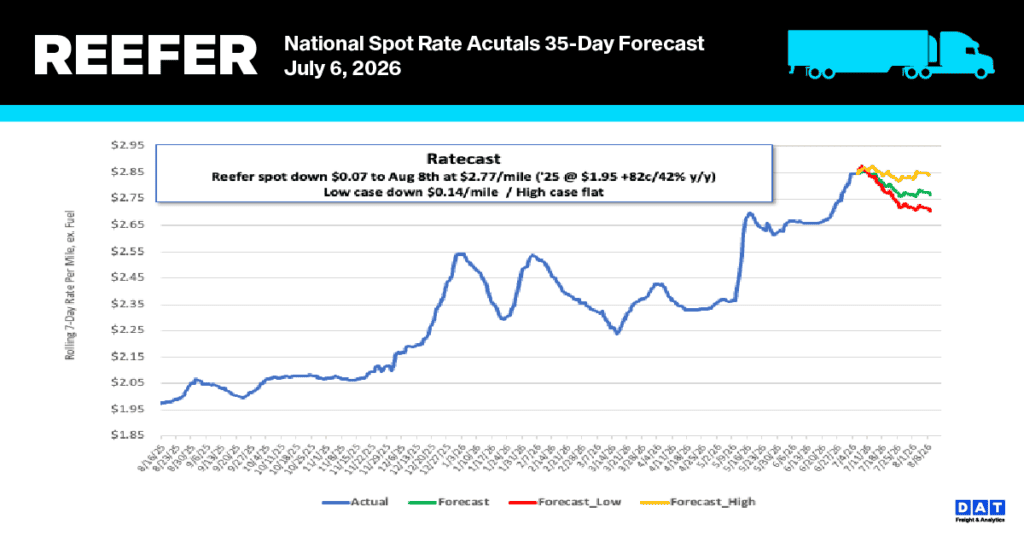
National reefer linehaul rates jumped by $0.10 per mile last week, reaching $2.85 as the nation celebrated the U.S. 250th Anniversary during the Independence Day holiday, the close of the month and quarter. This 7-day rolling average sustained the peak performance seen during Roadcheck Week, finishing 21% ($0.49) above early May levels. Current spot pricing for reefers is 39% ($0.80) higher than last year and 28% ($0.78) above the non-pandemic five-year norm, matching the Week 26 record established in 2021.
- Bellwether Performance (IL, IN, TX, OH, TN, WI, AR, KY, MO, PA): Rates in this 10-state “food engine room” market—accounting for 43% of national volume—rose $0.13 to $3.23 per mile as capacity loosened. Unlike seasonal produce hubs, these states rely on year-round staples like dairy, poultry, and processed foods, providing a more consistent barometer for the national reefer market.
Trends in the produce sector
Last week, spot rates in key produce hubs climbed by $0.18, reaching an average of $4.22 per mile and maintaining a $0.62 lead over last year’s figures. Although USDA data indicates volumes have decreased by approximately 10% year-over-year, this gap may narrow due to typical volume lags. Despite these lower volumes, California reefer rates—including frozen goods—have surged to $1.22 per mile (50%) above previous year levels, driven by restricted West Coast capacity and immigration enforcement.
Reefer Market Conditions
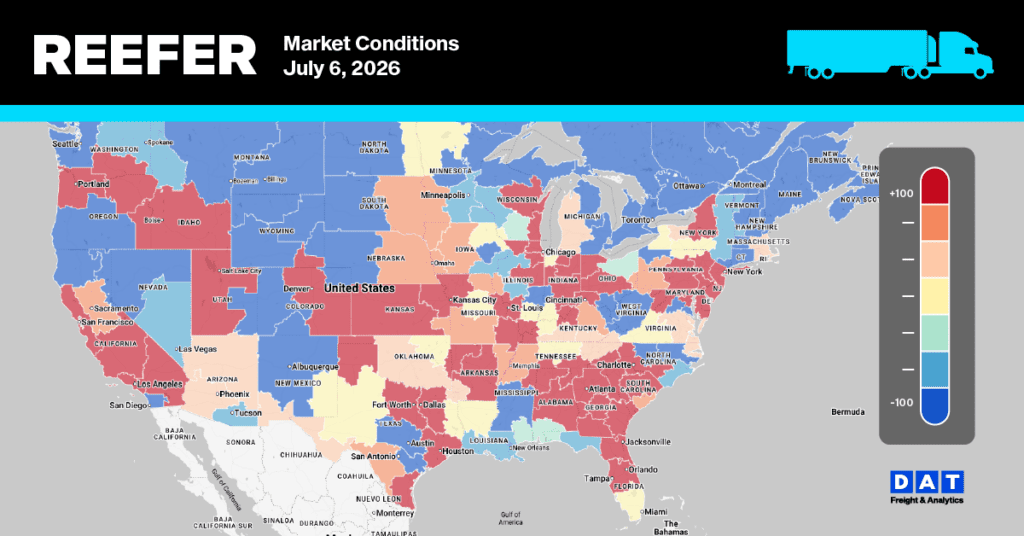
Load post volumes decreased by 17% during the shortened workweek, yet they remained 32% above the previous year’s levels. Concurrently, the national reefer load-to-truck ratio settled at 22.06 after a 9% decline, marking a 68% year-over-year increase.
Weekly reports
The post Produce report: Shortage eases, surplus returns appeared first on DAT Freight & Analytics – Blog.