

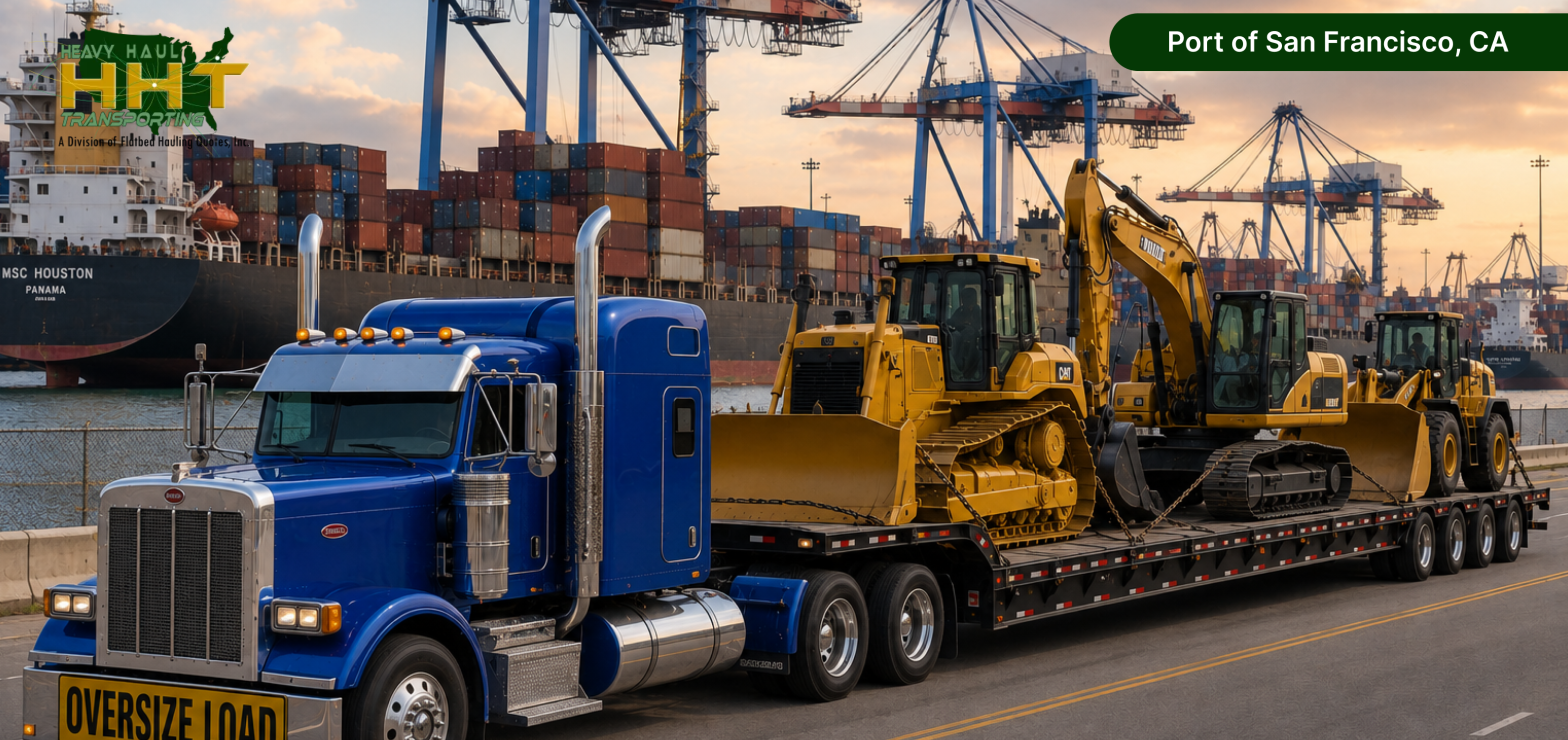
Heavy Haulers Port of San Francisco, CA
Moving Oversized Freight Beyond the Port
Heavy Haulers Port of San Francisco moves oversized freight into one of the most active logistics zones on the West Coast. At the Port of San Francisco, CA, Heavy Haul Transporting supports over-the-road moves for cargo that has already cleared the port gate and needs to reach job sites, yards, plants, and project locations across the country.
San Francisco plays a meaningful role in U.S. trade and regional economic development, especially for manufacturing, construction, consumer goods transport, and specialized industrial projects. The San Francisco port area also connects to freight tied to aerospace, defense contracting, alternative energy, and data center equipment, all of which can create demand for oversized load transport and heavy equipment transportation companies. Once cargo leaves the terminal, road transport becomes the practical link between the port and inland destinations.
That is where Heavy Haulers Port of San Francisco matters most. We move heavy freight by road only, using the right trailer and route plan for the load. We do not handle loading or unloading, customs brokerage, warehousing, ocean freight, or freight forwarding. Instead, our focus stays on heavy haul trucking, route planning, and getting oversized equipment onto California highways with the right permits and clearances.
Port Industries and Economic Impact
Heavy Haulers Port of San Francisco serves a market shaped by construction, manufacturing, energy, and public infrastructure work. The Port of San Francisco, CA sits in a region where project cargo often includes structural steel, electrical substation modules, power transformers, industrial boilers, and pre-fabricated building modules. Those shipments create steady demand for heavy haul transportation and oversized load trucking because many pieces are too tall, too wide, or too heavy for standard freight equipment.
The San Francisco port area also supports movement tied to alternative energy and solar projects, along with industrial equipment for commercial water treatment, control rooms, and power stations. In a city and region with ongoing economic development, Heavy Haulers Port of San Francisco often sees freight that must move quickly from the gate to a construction site or fabrication yard. That is especially true for heavy equipment haulers working with cranes, excavators, bulldozers, and rock crushers that support local and statewide projects.
International trade adds another layer of demand. Cargo arriving through the Port of San Francisco, CA may include consumer goods transport equipment, military suppliers’ freight, or aerospace components that need careful over-the-road handling. Flatbed trucking companies and heavy equipment transportation companies are often called in when a load needs a direct highway move after port release. In this market, timing, routing, and permit compliance matter just as much as horsepower.
Heavy Freight Moving Through the Port
Heavy Haulers Port of San Francisco handles a wide range of freight that fits the needs of construction, energy, and industrial customers. At the Port of San Francisco, CA, common moves include excavators, articulated dump trucks, motor graders, soil compactors, concrete pumpers, and asphalt pavers. We also see oversized freight shipping for industrial boilers, large generators, power transformers, and electrical cabinets that support utility and manufacturing projects.
For bigger loads, Flatbed Heavy Haulers and Flatbed Equipment Movers often rely on step deck trailers, lowboy trailers, RGN trailers, and double drop trailers. Multi-axle trailers help spread weight on heavier pieces, while Schnabel trailers can be useful for very specialized over-dimensional hauling. Heavy machinery haulers may also move tunnel boring machines, drilling rigs, pipe strings for pipelines, and complete bridge sections when a project calls for large-scale transport.
Heavy Haul Transporting matches the trailer to the freight, not the other way around. Flatbed transportation companies often handle structural steel beams, trusses, and pre-fabricated building modules, while heavy haul shipping companies may take on oversized equipment and machinery hauling services for cranes, large metal forgings, and storage tanks. In the San Francisco port area, that flexibility matters because one load might be a compact industrial machine and the next might be a massive energy component that needs over-dimensional hauling support.
Transportation Challenges and Route Planning
Heavy Haulers Port of San Francisco requires careful planning because California rules for oversized load transport can change based on dimensions, weight, and travel time. At the Port of San Francisco, CA, permits must match the exact load size, axle setup, and route. Heavy haul trucking in California also has to account for height restrictions, weight limits, bridge clearances, and local travel windows that can affect when a load can move.
Route surveys are a big part of the job. Our drivers and planners look at turning radius, lane width, overhead signs, utility lines, and bridge approaches before a load leaves the San Francisco port area. That matters for heavy equipment transport carrying tall items like electrical substation modules, cooling towers, or large telecommunication antennas and towers. Weather also plays a role. Wind along the waterfront can affect tall freight, and fog can slow visibility on approaches to US-101, I-280, and CA-1.
Fuel prices matter too. When diesel costs rise, route efficiency and timing become even more important for heavy haul transportation. Heavy equipment transportation companies that work from the Port of San Francisco, CA need to balance permit timing, escort needs, and highway access with the practical cost of moving a load across California. Good planning keeps oversized load trucking on schedule and reduces avoidable delays after the cargo leaves the gate.
Heavy Haul Transporting provides road-only service from the Port of San Francisco, CA to destinations across the United States. Heavy Haulers Port of San Francisco is part of our regular work, and our fleet includes flatbeds, step decks, lowboys, RGNs, double drops, multi-axle trailers, and specialized equipment for oversized load transport. We handle the over-the-road move after cargo clears the port gate, and we keep the focus on safe highway transport rather than port operations.
Heavy Haulers Port of San Francisco supports the freight flow that keeps construction, energy, manufacturing, and infrastructure projects moving. At the Port of San Francisco, CA, oversized freight often needs a road carrier that understands permits, clearances, and the realities of California highways. Heavy Haul Transporting is ready for that work when the load is ready to leave the gate and head inland. If your project needs heavy haul trucking from the San Francisco port area, the right route and trailer choice can make the difference.
Planning Heavy Haul Transport From Port of San Francisco, CA?
Heavy Haul Transporting helps businesses coordinate the movement of oversized freight, industrial machinery, construction equipment, and project cargo throughout North America.
Primary Road Corridors Out of Port of San Francisco, CA
The Port of San Francisco, CA connects oversized freight to major transportation corridors across Texas and the United States. These highways are frequently used for moving construction equipment, refinery components, heavy machinery, wind energy equipment, and oversized industrial cargo after it leaves the port area.
US-101 is one of the most important corridors for Heavy Haulers Port of San Francisco because it links the Port of San Francisco, CA with regional industrial zones, job sites, and distribution points. Heavy Haulers Port of San Francisco often uses this route for construction equipment, electrical cabinets, and industrial machinery that need direct access to the Bay Area freeway network. For oversized load transport, US-101 matters because it offers a practical path for loads moving out of the waterfront and toward inland California destinations.
I-280 gives Heavy Haulers Port of San Francisco a useful southbound option from the Port of San Francisco, CA when freight needs to bypass denser city traffic. Heavy Haulers Port of San Francisco may route heavy equipment transport, flatbed shipping, and over-dimensional hauling on this corridor for loads such as structural steel, generators, and modular structures. It matters because I-280 can support planned moves that need careful timing, bridge checks, and smoother access to the Peninsula and beyond.
CA-1 can be important for Heavy Haulers Port of San Francisco when the Port of San Francisco, CA needs access to coastal destinations or local project sites with limited alternatives. Heavy Haulers Port of San Francisco uses this corridor cautiously for oversized freight shipping, especially when the load includes heavy machinery transportation, utility components, or construction equipment. The route matters because coastal geometry, turns, and clearance points can affect how a heavy haul trucking move is planned.
I-80 and nearby Bay Area connectors help Heavy Haulers Port of San Francisco reach broader Northern California markets from the Port of San Francisco, CA. Heavy Haulers Port of San Francisco may use these routes for heavy equipment haulers moving cranes, mining equipment, or industrial manufacturing freight toward inland corridors. For oversized load transport, these connections matter because they open access to wider freight lanes once the cargo leaves the waterfront.
Frequently Asked Questions About Port of San Francisco, CA Transportation
The Port of San Francisco, CA, handles various oversized freight, including heavy machinery, construction equipment, and large industrial components. These items often require specialized transport solutions, making heavy haulers essential for safe and efficient delivery.
In California, heavy haulers need to secure specific permits based on the cargo's dimensions and weight. It's crucial to check local regulations and route restrictions to ensure compliance and avoid delays when transporting oversized loads from the Port of San Francisco, CA.
For heavy hauling from the Port of San Francisco, CA, flatbed and lowboy trailers are commonly used. These trailers offer the necessary support for oversized cargo, ensuring stability and safety during transport. Heavy Haul Transporting can help you select the right equipment.
The Port of San Francisco, CA, serves various industries, including construction, energy, and manufacturing. These sectors frequently require heavy hauling services for transporting oversized equipment and materials, making it a vital hub for logistics managers.
After cargo leaves the Port of San Francisco, CA, heavy haulers coordinate the transport to its final destination. This involves route planning, securing necessary permits, and ensuring compliance with local regulations to facilitate smooth road transport.
Yes, California has specific route restrictions for heavy haulers, including weight limits and height clearances. It's essential to plan your route carefully to avoid obstacles and ensure compliance when transporting cargo from the Port of San Francisco, CA.
To schedule heavy hauling from the Port of San Francisco, CA, contact Heavy Haul Transporting. They will assess your cargo needs, plan the route, and handle all necessary permits to ensure a smooth transport process.
Transporting oversized loads from the Port of San Francisco, CA, can present challenges such as navigating urban traffic, adhering to local regulations, and securing appropriate permits. Partnering with experienced heavy haulers like Heavy Haul Transporting can help mitigate these issues.
NOAA Port Intelligence Related Pages
RELATED POSTS
Heavy Haulers Port of Tillamook and the road moves that keep freight flowing
Heavy Haulers Port of Chelan Moves Oversized Freight Across Washington Roads
Heavy Haulers Port of Tacoma: Moving Oversize Freight Across Washington by Road